Auyan-tepui: The Mountain Behind Angel Falls
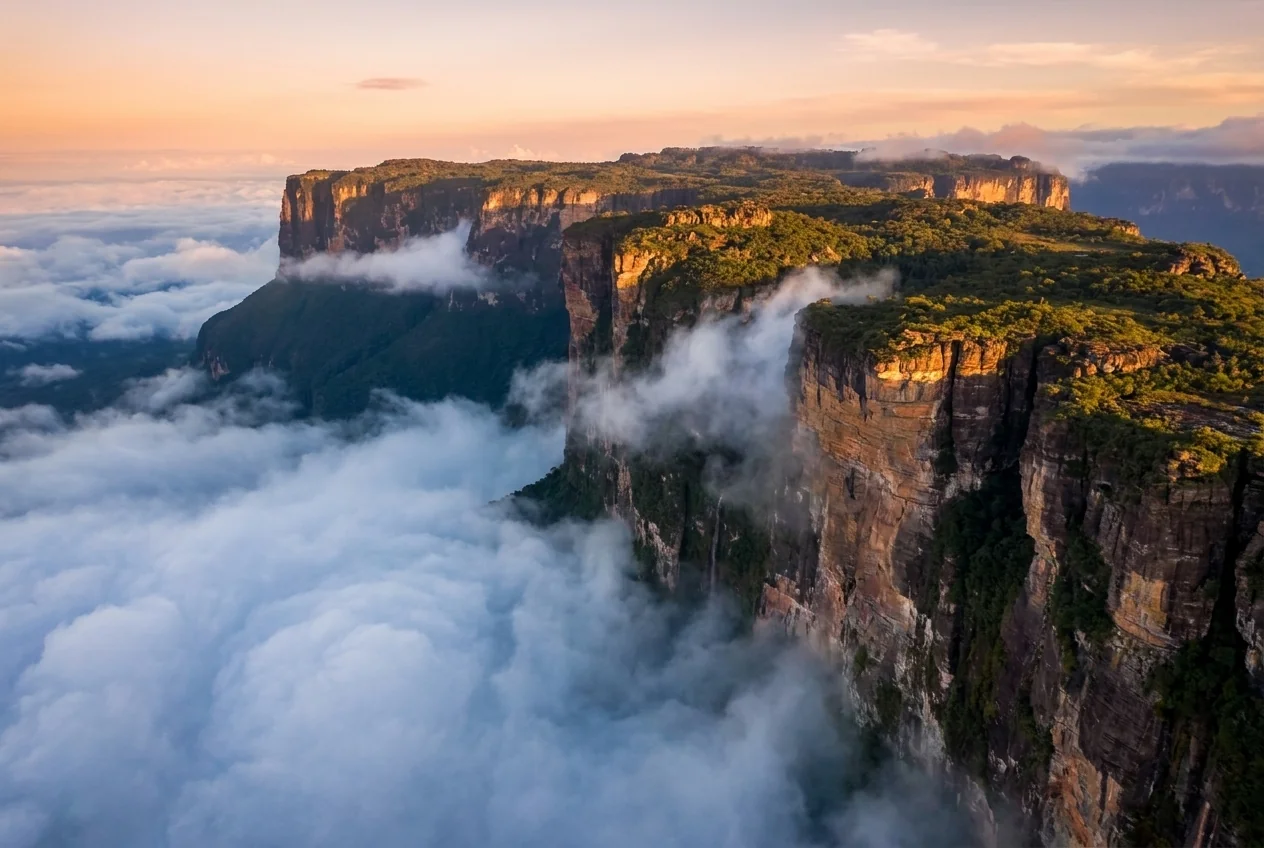
You cannot understand Angel Falls without understanding the mountain it falls from. Auyan-tepui is one of the largest of Venezuela's tepuis, a vast sandstone table mountain rising abruptly from the jungle, and Angel Falls simply pours off its western edge. To the Pemon it is Devil's Mountain, a name that captures the awe of its cloud-wrapped cliffs. This is a mountain older than almost anything alive, holding its own weather and its own isolated world on top. Knowing Auyan-tepui transforms the falls from a lone spectacle into the dramatic edge of one of Earth's most ancient landscapes.
A Mountain That Made the Falls
Angel Falls exists because Auyan-tepui exists. Rain that gathers on the mountain's immense summit spills over the western rim and falls, uninterrupted, for 807 meters before continuing to a total of 979 meters, making it the tallest waterfall on Earth. The mountain is both the source of the water and the towering cliff that gives the falls their extraordinary height.
Auyan-tepui is not a peak but a plateau, a flat-topped massif with a summit area of roughly 700 square kilometers, one of the largest of all the tepuis. Its sheer walls rise thousands of feet from the surrounding jungle and savanna, and its rim is cut and folded, which is why the falls emerge where they do.
So when you look at Angel Falls, you are really looking at the edge of Auyan-tepui. The waterfall is the mountain's most famous feature, but it is only one detail on a vast, ancient landform that dwarfs it. To grasp the falls, start with the mountain that made them.
Ancient Rock, Deep Time
The tepuis are among the oldest landscapes on the planet. Auyan-tepui is built from the sandstone of the Roraima Formation, quartz-rich rock laid down on a timescale measured in hundreds of millions to over a billion years, making it some of the most ancient exposed rock anywhere on Earth. Standing before it, you are looking deep into the planet's past.
These table mountains are the eroded survivors of a once-continuous plateau. Over immense spans of time, erosion stripped away the softer surrounding material and cut the plateau into isolated blocks, their sheer cliffs marking where the hard sandstone resisted. Auyan-tepui is one of these surviving fragments, weathered into its present dramatic form.
This deep-time origin is part of what makes the place feel otherworldly. The forest at the mountain's base is young by comparison; the rock above predates it almost beyond comprehension. Angel Falls pours from the flank of a landform that has stood, in some form, since long before the modern living world took shape.
The Summit and Devil's Canyon
The top of Auyan-tepui is a world of its own. The summit is a rugged expanse of weathered rock rising to elevations around 2,450 meters, and it is not a smooth tabletop but a folded, canyon-cut plateau. A great cleft, often called the Canon del Diablo or Devil's Canyon, carves deep into the massif, giving the summit its distinctive divided shape.
Up here, isolated for so long from the lowlands, conditions are cooler, wetter, and often shrouded in mist. Such tepui summits are famous for harboring plants and creatures adapted to their harsh, sky-island environment, some found nowhere else. The top of Auyan-tepui is a different realm from the jungle far below.
It was onto this boggy, broken summit that the aviator Jimmie Angel famously landed his plane in 1937, only to have it stick fast in the soft ground. The summit's remoteness and difficulty, the very qualities that stranded him, are what make Auyan-tepui feel like a lost world suspended above the forest.
Devil's Mountain: The Pemon View
To the Pemon people, the indigenous inhabitants and stewards of this land, Auyan-tepui is far more than a geological feature. Its name is commonly translated as Devil's Mountain, a reflection of the awe and unease inspired by its immense, cloud-wreathed presence and the powerful forces associated with such places in Pemon understanding.
The tepuis in general hold deep meaning in Pemon culture; the very word tepui is often rendered as house of the gods. These mountains are woven into story, belief, and a spiritual relationship with the landscape that long predates any outside interest in the region. Auyan-tepui, as one of the greatest of them, carries particular weight.
For visitors, holding this indigenous perspective matters. The mountain and its falls are not empty scenery to be consumed; they sit within a living cultural landscape. Traveling with Pemon guides, who know the mountain's stories as well as its trails, is both the respectful and the richer way to encounter Auyan-tepui.
Seeing Auyan-tepui on a Trip
You experience Auyan-tepui throughout an Angel Falls trip, whether or not you realize it. On the river journey, the mountain grows steadily larger ahead until its cliffs fill the sky above the jungle. From a scenic flight, you see the whole massif and the falls together, the only way to take in the mountain's true scale. At the base of the falls, you stand directly beneath its western wall.
Few ordinary visitors reach the summit itself; that is the realm of serious, well-organized expeditions, since climbing onto a tepui is a demanding undertaking. For nearly everyone, Auyan-tepui is experienced from below and from the air, which is more than enough to feel its immensity.
So as you plan your trip, think of it as a visit to a mountain as much as to a waterfall. Watching Auyan-tepui reveal itself from the canoe, or seeing it entire from a light plane, is one of the great sights of the journey, and it gives the falls the context that makes them comprehensible.
Why the Mountain Deserves Your Attention
It is easy to fixate on the waterfall and treat the mountain as its backdrop, but that gets the relationship backwards. Auyan-tepui is the main event; Angel Falls is one spectacular detail of it. Giving the mountain your attention rewards you with a deeper, more complete sense of the place.
Consider what it represents: an island of ancient rock older than the surrounding living world, a summit sealed off into its own ecosystem, a sacred landmark in Pemon culture, and the stage for one of the twentieth century's great aviation adventures. Few mountains carry so many layers of meaning at once.
When you finally see Auyan-tepui, from the river, the air, or the base of the falls, let it register as more than scenery. You are in the presence of one of the oldest and most extraordinary landforms on Earth, and the tallest waterfall on the planet is simply the water taking its most famous leap from the mountain's edge.
One of Many Sky-Islands
Auyan-tepui is the most famous of its kind, but it is not alone. Canaima National Park holds more than a hundred tepuis, each a flat-topped island of ancient rock rising from the lowlands, and together they form one of the most distinctive landscapes on Earth. Auyan-tepui stands out for its sheer size and for the waterfall it produces, but it belongs to a whole family of sky-islands.
These isolated summits have long fascinated outsiders, and the idea of remote highlands where the ancient past survives helped inspire tales of lost worlds full of prehistoric life. The fiction stretched the truth, but the kernel is real: because tepui summits have been cut off for so long, they do host unique plants and creatures adapted to their harsh conditions, evolutionary experiments running in isolation.
Seeing Auyan-tepui in this wider context deepens its meaning. It is not a single strange mountain but the greatest member of an entire archipelago of ancient plateaus, each holding its own weather, its own life, and its own place in Pemon geography. Angel Falls is the most spectacular expression of a landscape defined by these extraordinary mountains.
Key Takeaway
Auyan-tepui is the real story behind Angel Falls: a vast, ancient sandstone table mountain, older than almost anything alive, whose western rim gives the world's tallest waterfall its height. To the Pemon it is Devil's Mountain, a sacred landmark in a living cultural landscape, and its mist-wrapped summit is a sky-island world of its own. See the falls as the edge of this mountain rather than a lone spectacle, and travel with the Pemon who steward it, and Angel Falls becomes part of something far larger and older than a single view.