Birdwatching in Venezuela: A Complete Guide to Canaima and Beyond
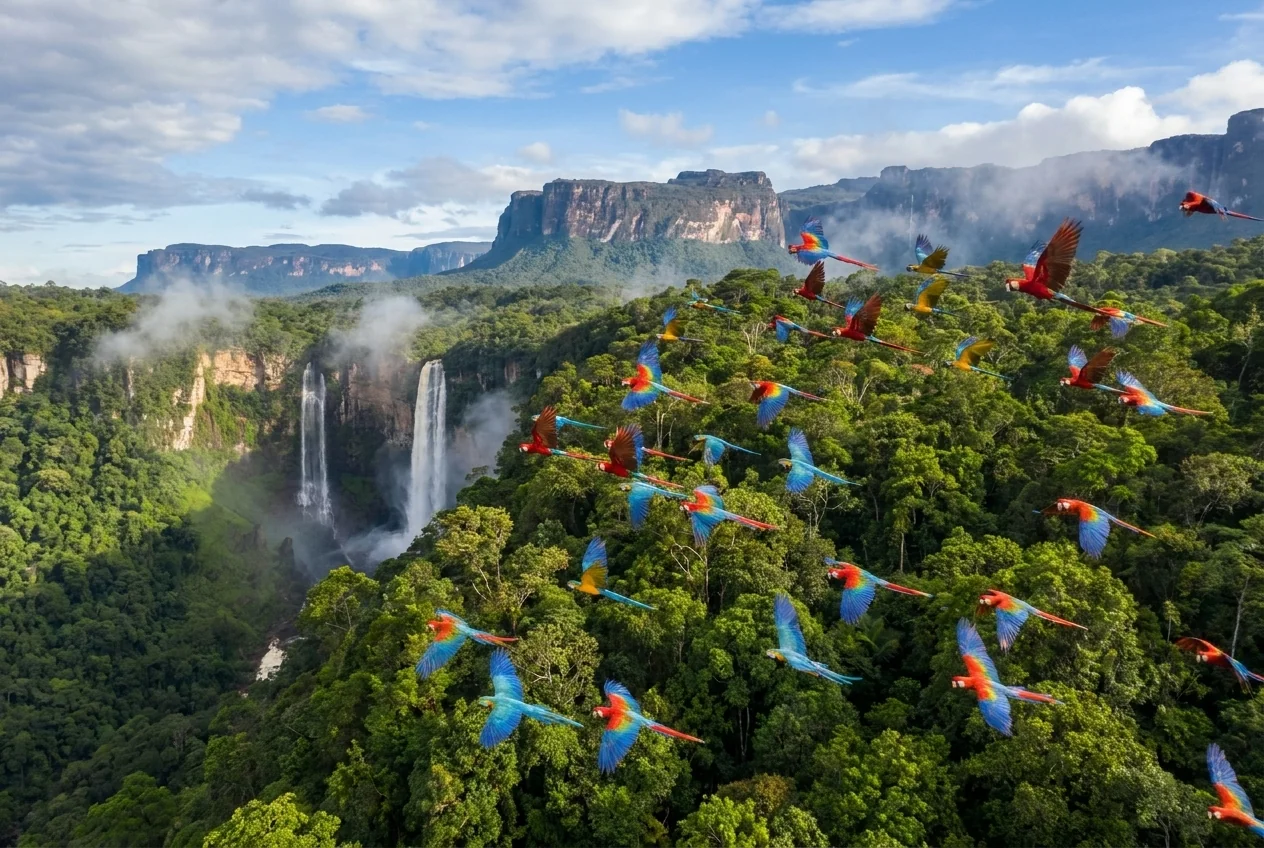
Venezuela ranks fifth in the world for bird species, with over 1,400 documented species packed into an area smaller than Texas. For birders, this country is staggeringly productive. In a single two-week trip, you can log tepui endemics found nowhere else on Earth, scan flooded llanos teeming with herons and jabiru storks, paddle through Orinoco Delta mangroves watching scarlet macaws overhead, and hike cloud forests dense with tanagers and hummingbirds. Despite the country's political challenges, its birds have not gone anywhere. This guide covers where to go, what to look for, when to visit, and how to combine world-class birding with a trip to Angel Falls.
Venezuela's Birding Credentials
The numbers tell the story. Venezuela hosts approximately 1,420 bird species, placing it behind only Colombia, Brazil, Peru, and Indonesia globally. Within a territory of 916,000 square kilometers, you find 10 distinct habitat zones: Caribbean coast, Andean cloud forest, llanos grasslands, tepui highlands, Amazonian rainforest, Orinoco Delta mangroves, dry forest, gallery forest, paramo, and marine islands.
This habitat diversity produces remarkable species density. Henri Pittier National Park alone (just 1,078 square kilometers near the coast) holds over 580 recorded species. Los Llanos, the vast seasonal wetlands of the interior, supports one of the highest concentrations of waterbirds in the Americas. The tepui highlands of Bolivar state harbor approximately 50 endemic or near-endemic species that evolved in isolation atop these ancient sandstone plateaus.
Venezuela also sits on major migration routes. Between October and March, Nearctic migrants (warblers, shorebirds, raptors) pass through in large numbers, adding seasonal variety to the resident species. A well-planned birding trip during November can catch both resident specialties and migrant waves.
Despite reduced tourism in recent years, Venezuela's birding infrastructure still functions. Local guides remain active, key lodges continue to operate, and the birds themselves are arguably less disturbed than a decade ago due to lower visitor numbers. For serious listers, Venezuela represents both an underbirded frontier and a competitive advantage.
Canaima and the Tepui Region: Endemic Specialties
The tepui highlands of Canaima National Park are the birding equivalent of the Galapagos: isolated ecosystems that evolved unique species found nowhere else. The flat-topped tepui mountains (rising 1,000 to 2,800 meters above the surrounding jungle) create sky islands where populations have been genetically isolated for millions of years.
Key tepui endemics to target include the tepui swift (Streptoprocne phelpsi), a large swift that nests exclusively on tepui cliff faces. The roraiman barbtail (Roraimia adusta), a small furnariid restricted to tepui summit scrub above 1,200 meters. The tepui parrotlet (Nannopsittaca panychlora), a tiny green parrot found in montane forest on tepui slopes. The tepui goldenthroat (Polytmus milleri), a hummingbird of tepui edge habitats.
Around Canaima village and the lagoon, birding is productive without any special effort. You will regularly see orange-winged parrots, blue-and-yellow macaws, channel-billed toucans, and various tanagers from the posada grounds. The river journey to Angel Falls adds swallow-winged puffbirds, black-headed parrots, and occasional king vultures soaring above the canyon.
For serious tepui birding, the Mount Roraima trek is the premier option. The 6-day round trip to the summit passes through four distinct habitat zones, each with characteristic species. The summit plateau itself (2,810 meters) has sparse vegetation but hosts the Roraima bush toad and several endemic plant species. See our Mount Roraima trek guide for logistics.
For a broader understanding of these unique geological formations and why they support such distinctive wildlife, read our tepui explainer.
Los Llanos: Waterbird Paradise
If the tepuis offer endemic rarities, Los Llanos delivers sheer abundance. These vast seasonal wetlands (covering roughly 300,000 square kilometers across Venezuela and Colombia) produce some of the most spectacular waterbird concentrations in the Western Hemisphere.
During the dry season (December through April), receding waters concentrate birds around remaining pools and rivers. You can stand in one spot and count 15 to 20 species of wading birds: jabiru storks (standing 1.5 meters tall), roseate spoonbills, wood storks, various herons and egrets, and limpkins. Scarlet ibis gather in flocks of hundreds. Hoatzins, the bizarre leaf-eating birds with clawed wings as chicks, perch in gallery forest along waterways.
Raptors are equally impressive. Savanna hawks, yellow-headed caracaras, and pearl kites are common. The ornate hawk-eagle and the rare crested eagle require more luck. Snail kites are everywhere, plucking apple snails from the shallows.
Several ranches (hatos) in Los Llanos operate as eco-lodges and birding bases. Hato El Cedral and Hato Pinero are the most established, offering guided boat trips, horseback rides, and walking excursions through prime habitat. A 3 to 4 day stay is sufficient to accumulate a strong species list.
For a complete guide to the Los Llanos experience (including wildlife beyond birds), see our Los Llanos wildlife safari guide.
Orinoco Delta and Henri Pittier: Complementary Habitats
The Orinoco Delta, where South America's third-largest river meets the Atlantic, is a vast labyrinth of channels, mangroves, and palm swamps. Birding here is done primarily from boats, paddling through narrow channels where the canopy closes overhead.
Target species in the delta include scarlet macaws (large, noisy flocks are regular), red-bellied macaws, blood-colored woodpecker, point-tailed palmcreeper, and the delta amacuro softtail (a recently described species with an extremely restricted range). The delta also supports healthy populations of harpy eagles, though sightings require luck and time with local Warao guides who know the nest sites.
A 2 to 3 day delta trip from Tucupita adds 40 to 80 species to your trip list, many of them habitat specialists you will not encounter elsewhere on a Venezuela itinerary.
Henri Pittier National Park, on the Caribbean coast near Maracay, is Venezuela's oldest national park and one of its most bird-rich. The road from Maracay to the coast climbs through dry forest, cloud forest, and coastal scrub, all within 50 kilometers. This elevation transect produces staggering diversity. The park list exceeds 580 species.
Key targets at Henri Pittier include the handsome fruiteater, golden-breasted fruiteater, Venezuelan sylph (a spectacular long-tailed hummingbird), helmeted curassow, and numerous tanagers. The Rancho Grande Biological Station at Portachuelo Pass is a legendary migrant trap during October and November, when thousands of raptors, swallows, and warblers funnel through the pass.
For birders with limited time, Henri Pittier can be covered in 2 to 3 days from Caracas. It pairs well with an arrival or departure buffer, letting you bird productively near the capital without venturing into urban risk zones.
Best Seasons and Planning Your Birding Itinerary
The optimal birding season depends on which habitats you prioritize. There is no single "best" month for all of Venezuela.
For tepui endemics (Canaima, Gran Sabana, Roraima): visit during the rainy season, June through October. Water levels are high enough for the canoe trip to Angel Falls, and the tepui forests are lush and active. Bird activity peaks in the early morning hours before afternoon rain.
For Los Llanos waterbirds: visit during the dry season, December through April. Receding water concentrates birds and makes them easier to find and photograph. March and April are peak months, with the highest density of birds around shrinking pools.
For Henri Pittier migrants: visit October through November. The Portachuelo Pass migration is best in late October, when raptor and passerine movements are at their peak.
For Orinoco Delta: the dry season (January through April) offers lower water levels and more concentrated bird activity, though the delta is birdy year-round.
A comprehensive 2-week Venezuela birding trip might follow this sequence: fly into Caracas, transfer to Henri Pittier for 2 to 3 days, fly to Ciudad Bolivar and continue to Canaima for 3 to 4 days (combining Angel Falls with tepui birding), drive the Gran Sabana for 2 days, then fly to Los Llanos for 3 to 4 days. This itinerary typically yields 350 to 500+ species depending on experience and effort.
A shorter trip focused on combining Angel Falls with birding should allocate 4 to 5 days in the Canaima/Gran Sabana region. You can realistically log 150 to 200 species while also experiencing the falls.
Equipment and Field Guides
Binoculars are your primary tool. Bring a high-quality pair in the 8x42 or 10x42 range. Waterproofing is essential given the humidity and rain in Canaima and the delta. Swarovski EL, Zeiss Victory, and Nikon Monarch are all proven in tropical conditions. Whatever you bring, make sure it is fog-proof.
A spotting scope is useful in Los Llanos (open habitats, distant waterbirds) but unnecessary and cumbersome in Canaima (dense forest, poor visibility beyond 30 meters). If you are doing a multi-region trip, bring a lightweight scope for the llanos and leave it locked in your luggage during the forest segments.
For field guides, the definitive reference is "Birds of Venezuela" by Steven Hilty (2003). Despite its age, it remains the standard. A newer digital option is the Merlin Bird ID app by Cornell Lab, which includes Venezuela species with sound recordings. Download the full Venezuela pack before your trip, as you will have no data in Canaima. The eBird app is essential for recording sightings and finding recent hotspot data.
Bringing a camera for bird photography adds weight and complexity. If photography is a priority, a 100-400mm zoom on a mirrorless body is the best compromise between reach and portability. Forget about tripod-mounted super-telephoto setups in the jungle. Handheld shooting is the only practical approach on trails and in canoes.
Pack your optics in a waterproof dry bag for river transport. Bring lens cloths, anti-fog wipes, and a rain cover for your binoculars. Morning dew and afternoon rain will test every piece of gear you own.
Guides, eBird Hotspots, and Combining Birding with Angel Falls
Local birding guides transform your species count. A knowledgeable guide in Canaima or Henri Pittier will find 30 to 50 percent more species than you would on your own, particularly skulkers and canopy species that require trained ears. Venezuelan birding guides typically charge $80 to $150 per day. Some specialize in specific regions.
For Canaima and the Gran Sabana, your Pemon river guides know the large, visible species (macaws, toucans, raptors) but are generally not trained birders. If you want serious tepui birding, arrange a dedicated birding guide through a specialty operator. David Ascanio (Ascanio Birding) and Raul Arias de Para are among the most experienced Venezuelan birding guides, though availability should be confirmed well in advance.
eBird hotspots in Venezuela are less densely reported than in North America or Europe, but several locations have strong checklists. Key hotspots to review before your trip: Canaima Lagoon, Kavak (Gran Sabana), Rancho Grande (Henri Pittier), Hato El Cedral (Los Llanos), and Tucupita (Orinoco Delta). These checklists will help you build target species lists for each location.
Combining birding with an Angel Falls trip is straightforward. The river journey to the falls passes through prime habitat. Bring your binoculars on the canoe and ask your guide to slow down when you spot something. The early morning hours at river camp (5:00 to 7:00 AM) are peak birding time, with dawn chorus filling the canyon. Many birders report that the hours around Angel Falls camp are among the most productive of their entire Venezuela trip.
Build buffer time into your Canaima stay. A standard 3-day Angel Falls tour leaves little time for dedicated birding. Adding 1 to 2 extra days in Canaima village lets you explore the lagoon edge, surrounding forest trails, and open savanna habitats at your own pace.