Gran Sabana Road Trip: The Ultimate Driving Guide for 2026
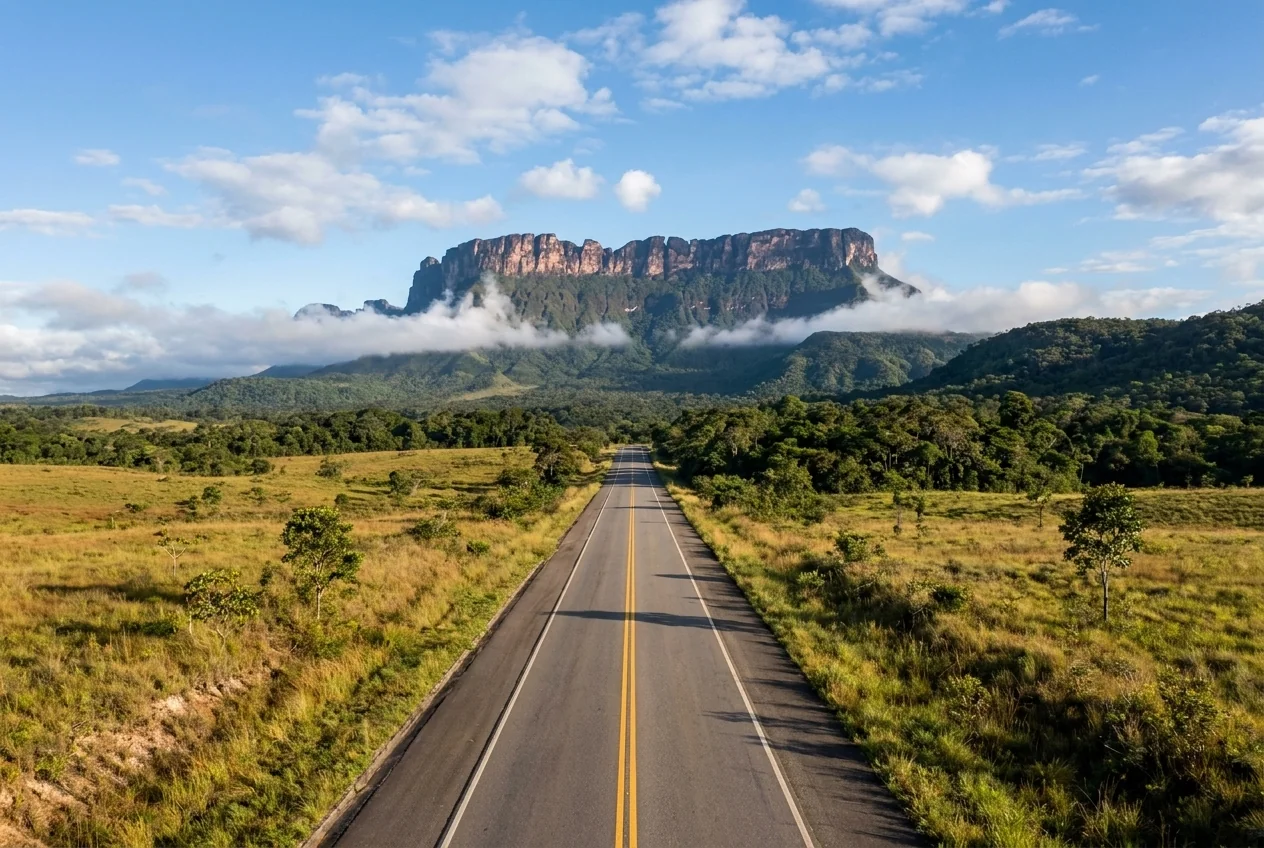
Route 10 cuts south through the Gran Sabana like a ribbon draped over the edge of the world. For 600 kilometers between Ciudad Bolivar and the Brazilian border town of Santa Elena de Uairen, you will drive past tabletop mountains that rise from the savanna floor, swim beneath waterfalls that have no name on any map, and pass through Pemon communities where life moves at a pace that makes you forget about schedules entirely. This guide covers the full route, every essential stop, and the practical details you need to plan a Gran Sabana road trip in 2026.
Understanding the Route: Ciudad Bolivar to Santa Elena
Route 10 is the only paved road through the Gran Sabana. It begins in Ciudad Bolivar (or Puerto Ordaz, depending on your starting point) and runs roughly 600 km south to Santa Elena de Uairen, the last Venezuelan town before Brazil. The entire drive takes 8 to 10 hours without stops, but nobody drives it without stopping. Most travelers spread it over 3 to 5 days.
The road climbs from the lowland heat of the Orinoco basin through La Escalera, a steep forested ascent that marks the boundary between the lowlands and the highland savanna. Once you crest La Escalera at roughly 1,400 meters, the landscape transforms completely. Flat grasslands stretch to the horizon, punctuated by tepuis and crisscrossed by rivers carrying tannin-stained water.
The best direction to drive is south, from Ciudad Bolivar toward Santa Elena. This puts the most dramatic scenery ahead of you as you climb into the highlands, and it means La Escalera's hairpin turns are an ascent rather than a nerve-testing descent. If you are combining this trip with Angel Falls, fly to Canaima first, then pick up a vehicle in Ciudad Bolivar for the overland portion.
Starting from Puerto Ordaz
If you fly into Puerto Ordaz (the most common international gateway to Bolivar state), the drive to the start of Route 10 proper takes about 90 minutes. Puerto Ordaz has better car rental options, more fuel stations, and larger supermarkets for stocking up. Plan to leave early in the morning so you can reach the base of La Escalera before dark on your first day.
Starting from Ciudad Bolivar
Ciudad Bolivar sits on the Orinoco River and is the historic gateway to the Gran Sabana. It has fewer rental agencies, but the colonial old town is worth a night if you are not in a rush. The airport also serves as a departure point for Canaima flights if you want to see Angel Falls before or after your road trip.
Road Conditions and Vehicle Requirements
The main Route 10 highway is paved and generally in reasonable condition, though potholes appear regularly, especially after the rainy season. You do not strictly need a 4x4 for the paved road itself. A standard sedan can make the full Puerto Ordaz to Santa Elena run. However, a high-clearance vehicle (ideally 4x4) is strongly recommended because the best stops along the route require turning off the highway onto unpaved tracks.
Access roads to Quebrada de Jaspe, Kavac, and several waterfall trailheads are rocky dirt roads ranging from 2 to 25 km. In the wet season (June to November), these side roads can become muddy and impassable without 4WD. A Toyota Hilux or similar pickup is the most common rental choice, and for good reason.
Drive only during daylight hours. The road has no lighting, cattle wander onto the pavement at night, and some stretches have no cell signal for calling help if something goes wrong. Plan to be at your accommodation by 5:30 PM at the latest.
Fuel Stations Along the Route
Fuel availability is one of the biggest planning challenges in the Gran Sabana. Official PDVSA stations exist at Puerto Ordaz, Km 88 (Las Claritas/El Dorado area), and Santa Elena de Uairen. Between Las Claritas and Santa Elena, a stretch of roughly 300 km, there is no guaranteed fuel. Fill your tank completely at every opportunity. Carry at least 20 liters of extra fuel in approved jerry cans. Some Pemon communities sell fuel informally at marked-up prices, but you cannot count on this.
The Must-Stop Waterfalls
The Gran Sabana has more waterfalls than anyone has bothered to count. Dozens are visible from the highway, and hundreds more hide in the bush a short walk from the road. These are the stops you should not skip.
Quebrada de Jaspe (Km 273)
A river of red jasper stone creates a natural waterslide about 300 meters long. The polished red rock beneath the flowing water looks almost artificial in its perfection. It is a sacred site to the Pemon people, so swimming is restricted in certain sections. Follow the posted signs and ask before entering the water. The turnoff from Route 10 is well-marked, and the walk from the parking area takes about 10 minutes.
Salto Kama (Km 201)
A 50-meter waterfall that drops into a deep pool surrounded by jungle. The trail from the road is about 1.5 km and takes 30 to 45 minutes each way. Pemon guides from the nearby community are available and recommended, as the trail forks in places. The swimming hole at the base is one of the best on the entire route, with clear, cool water even in the dry season.
Salto Aponwao (Chinak-Meru)
At 105 meters, this is one of the tallest accessible waterfalls on the Gran Sabana route. Reaching it requires a 4x4 drive to the Pemon community of Iboribó, followed by a short canoe crossing and a 2 km hike. Budget a full half-day for this detour. The Pemon community charges an entrance fee (approximately $5-10 per person) and provides guides. The viewpoint overlooking the falls is spectacular.
Kavac and the Cave of Kavac
Kavac is a small Pemon community about 60 km off Route 10, accessible via an unpaved road that requires a high-clearance vehicle. The main attraction is Kavac Canyon (La Cueva de Kavac), a narrow slot canyon carved through reddish sandstone with a waterfall at its end. You wade through chest-deep water to reach the falls, which drop into a natural pool enclosed by towering walls.
The experience is otherworldly. The canyon walls are tight enough to touch on both sides in places, and the light filtering down creates shifting colors on the wet rock. A Pemon guide is required, and the community provides one as part of the entry fee (around $10-15 per person).
Kavac also offers basic posada (guesthouse) accommodation and meals. Spending a night here is worthwhile if your schedule allows it. The village sits at the foot of Auyan-tepui, the same mountain from which Angel Falls drops, and the views at sunrise are extraordinary. This is also one of the possible starting points for overland expeditions to Angel Falls, though the standard route goes through Canaima.
Where to Stay Along the Route
Accommodation in the Gran Sabana falls into three categories: posadas (small guesthouses, often family-run), campamentos (organized campgrounds with basic facilities), and wild camping (bring your own gear, pitch where permitted). Hotels in the traditional sense do not exist between Puerto Ordaz and Santa Elena.
Posadas are your best bet for comfort. Most offer private rooms with beds, mosquito nets, and shared bathrooms. Some include meals prepared by the host family, typically hearty Venezuelan fare like arepas, beans, grilled chicken, and fresh juice. Expect to pay $20-40 per night for a double room, sometimes with meals included.
Key accommodation clusters exist at Las Claritas/El Dorado (near Km 88), along the stretch between Km 200 and Km 250 (near waterfalls and Pemon communities), and in Santa Elena de Uairen itself. Book ahead during July and August, which is peak season for Venezuelan and Brazilian tourists. During the rest of the year, you can usually find a room by asking around.
Camping in the Gran Sabana
Wild camping is technically possible in many areas, but always ask permission from the nearest Pemon community first. The land is indigenous territory. Organized campgrounds at places like Quebrada Pacheco and near Salto Kama offer flat ground, fire pits, and sometimes basic latrines. Bring a good rain fly, a hammock with mosquito net, and be prepared for cool nights at altitude (temperatures can drop to 12-15C at night on the highland plateau).
Pemon Communities and Responsible Tourism
The Gran Sabana is Pemon territory. The Taurepan subgroup of the Pemon people has lived here for centuries, long before the road existed. Their communities dot the entire route, and nearly every waterfall, viewpoint, and trail you visit will be on Pemon land.
Respect is not optional. Pay entrance fees without bargaining. Hire local guides when offered. Buy crafts directly from artisans rather than middlemen in Santa Elena. Ask before photographing people, homes, or ceremonies. These are not tourist attractions staffed by employees; they are living communities that have chosen to share parts of their world with visitors.
Many Pemon families supplement farming and fishing income by hosting travelers, guiding hikes, or selling handmade baskets and jewelry. Your spending goes directly to families, not to a corporation or distant government office. This is one of the most direct forms of community-based tourism you will find anywhere in South America.
If you visit during a festival or gathering, observe from the edges unless invited to participate. The Pemon are generally welcoming, but they did not build their traditions for an audience.
Security Considerations and Practical Logistics
The Gran Sabana route has a different security profile than Venezuelan cities. The main risks are not crime but logistics: running out of fuel, vehicle breakdowns in areas without cell signal, and getting stuck on muddy side roads. Violent crime targeting tourists on Route 10 is rare, though petty theft can occur if you leave valuables visible in a parked car.
There are military checkpoints (alcabalas) at several points along the route, particularly near Las Claritas and approaching Santa Elena. Carry your passport and vehicle documents at all times. Be polite, patient, and straightforward. Checkpoints typically take 5 to 15 minutes.
Cell phone coverage (primarily Movilnet and Digitel) is available in towns but disappears between them. Download offline maps before departure. Google Maps offline mode works well, and Maps.me has excellent coverage of Gran Sabana trails and side roads.
Carry basic supplies: first aid kit, water purification tablets, extra food for at least one day, a flashlight, and insect repellent with DEET. The nearest hospital is in Santa Elena or Puerto Ordaz, and reaching either from the middle of the route could take 4 or more hours.
Combining with Angel Falls
The most popular combination is to fly into Canaima for the Angel Falls excursion (3-4 days), then pick up a vehicle in Ciudad Bolivar and drive Route 10 south (3-5 days). Alternatively, drive the Gran Sabana first and fly to Canaima from Santa Elena (flights are available but less frequent than from Ciudad Bolivar). Either way, budget 7-10 days for both experiences. See our combined destinations guide for detailed itinerary options.