Best Helicopter Tours of Angel Falls: Routes, Prices, and Tips
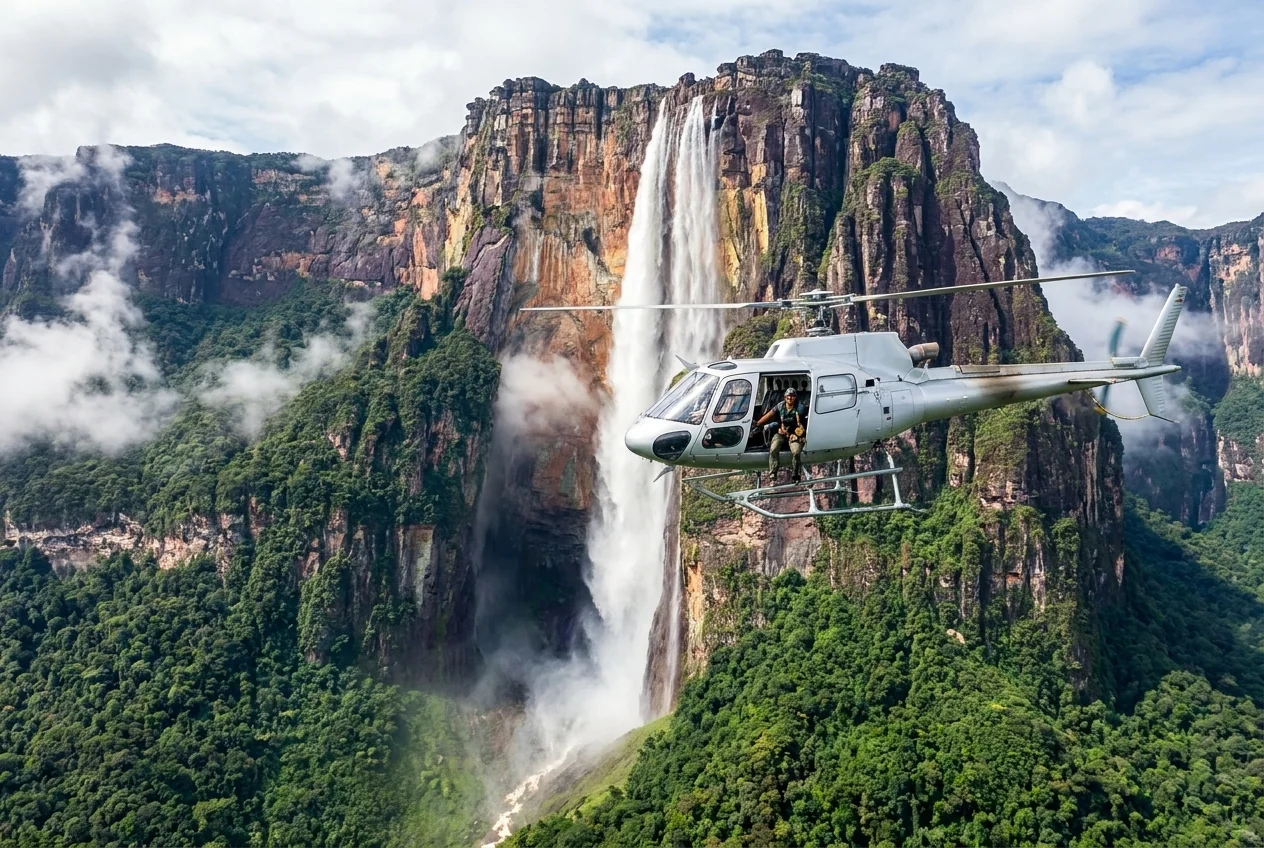
Seeing Angel Falls from the ground is extraordinary. Seeing it from the air is something else entirely. From 300 meters above, you can trace the entire 979-meter drop from the flat summit of Auyan-tepui down through the mist to the jungle floor below. You see the falls in context: a white thread falling from a massive tabletop mountain surrounded by unbroken wilderness in every direction. Aerial tours of Angel Falls are available by helicopter and small fixed-wing aircraft, and they are one of the most popular (and most weather-dependent) activities in Canaima. This guide covers what is available, what it costs, and how to maximize your chances of an unforgettable flight.
Types of Aerial Tours: Helicopter vs. Fixed-Wing
Two types of aircraft offer scenic flights over Angel Falls: helicopters and small fixed-wing planes (typically Cessna 206 or similar). Each has different advantages, and the one you choose depends on your priorities and budget.
Helicopter Tours
Helicopters are the premium option. They fly slower, hover near the falls for extended viewing, and can approach from multiple angles. A helicopter can hold its position while you photograph from different perspectives, something a fixed-wing aircraft cannot do. The downside is cost (roughly $250-350 per person) and availability. Helicopters operate from Canaima on a limited schedule, and during peak season, demand often exceeds supply. Flights typically carry 4 to 6 passengers and last 45 to 60 minutes.
Small Fixed-Wing Flights
Cessna and similar light aircraft offer a more affordable alternative at $150-200 per person. These planes fly past Angel Falls rather than hovering near it, making several passes at different altitudes. The viewing windows are smaller than a helicopter's open sides, but the flight covers more ground, often including views of other tepuis, rivers, and waterfalls across the park. Flights typically carry 3 to 5 passengers and last 40 to 50 minutes. Fixed-wing flights are more commonly available than helicopter tours and can operate in slightly less favorable weather.
What You See During the Flight
The standard aerial route departs from the Canaima airstrip and follows the Carrao and Churun rivers upstream toward Auyan-tepui. Within 15 to 20 minutes, the massive flat-topped mountain fills the horizon. As the aircraft approaches, Angel Falls comes into view on the mountain's northern face.
From the air, you see details invisible from the ground. The falls originate from a notch in the tepui's rim where water flows off the summit plateau. The initial free-fall drop is about 807 meters before the water hits a ledge and cascades another 172 meters to the base. On clear days, you can see the plunge pool at the bottom and the mist cloud that the falls generate as they hit the rocks.
The pilot typically makes two to three passes at different altitudes and angles. The first pass is usually at a distance for scale. The second brings you closer, flying alongside the falls at roughly the same elevation as the drop point. If conditions allow, a third pass goes lower, showing the falls from below with the tepui summit towering overhead.
Beyond Angel Falls, the flight reveals the sheer scale of Auyan-tepui (the largest tepui in the park at 700 square kilometers, roughly the size of a small city). You will also see other tepuis in the distance, the dark ribbon of the Churun River cutting through the jungle, and possibly other waterfalls on Auyan-tepui's flanks that are not accessible by any trail.
Pricing and Booking Logistics
Aerial tours of Angel Falls are booked in Canaima, not in advance from home. This is the single most important logistical fact to understand. There is no reliable online booking system for these flights. You arrange them after arriving in Canaima, either through your tour operator, your posada, or directly with the flight companies at the airstrip.
Pricing as of 2026 runs approximately: - Helicopter tour: $250-350 per person (45-60 minutes) - Fixed-wing scenic flight: $150-200 per person (40-50 minutes)
Prices vary with fuel costs, group size, and season. During peak months (July and August), prices tend toward the higher end and flights fill quickly. In the quieter months (September to November), you may be able to negotiate or find a flight on shorter notice.
Payment is almost always in cash (US dollars accepted everywhere). Some operators may accept bank transfers, but do not count on card readers. Bring enough cash to cover the flight plus a buffer for unexpected costs.
Flights require a minimum number of passengers (usually 3 to 4) to depart. If you are traveling solo or as a couple, you may need to wait for other travelers to fill the seats, or pay extra to guarantee departure. Tour operators can usually coordinate group bookings to avoid this problem.
Book your flight on your first day in Canaima if possible. This gives you backup days in case weather cancels the first attempt. Waiting until your last day is risky, as a single morning of low clouds can cancel your flight with no chance to reschedule.
Weather and Cancellations
Weather is the biggest variable in any Angel Falls aerial tour. The falls sit at the base of a 2,500-meter tepui that generates its own weather system. Low clouds frequently obscure the falls, particularly in the afternoon when convective clouds build. Morning flights have the best odds of clear conditions.
During the rainy season (June to November), the falls are at their most spectacular (full water volume, dramatic mist clouds), but cloud cover is more frequent. Roughly 30-40% of scheduled flights get cancelled or delayed due to weather during this period. The dry season (December to April) offers clearer skies and more reliable flight schedules, but the falls may be reduced to a thin ribbon or even a mist.
If your flight is cancelled, you will typically be offered a refund or rescheduled to the next available slot. This is why booking early in your trip matters. Travelers on a tight 2-day Canaima schedule who book their flight for the last morning frequently leave without an aerial view.
Pilots make the final go/no-go decision based on visibility at the falls, not conditions at the airstrip. It can be perfectly sunny in Canaima while Auyan-tepui is wrapped in cloud. Trust the pilot's judgment. Flying through mountain cloud is not worth the risk, no matter how disappointed you are.
Aerial Photography: Getting the Shot
An aerial tour of Angel Falls is a once-in-a-lifetime photography opportunity. Preparation makes the difference between stunning images and blurry disappointments.
For camera settings, use Shutter Priority mode at 1/1000 second or faster. The aircraft vibration and banking turns cause motion blur at slower speeds. Set ISO to Auto with a maximum of 3200. Use a wide aperture (f/4 or wider) to maximize light gathering. Shoot in RAW if your camera supports it.
Lens choice matters. A 24-70mm zoom is the most versatile option. You need wide angle (24-35mm) when the falls fill the window frame on close passes, and telephoto (70mm+) for the distant approach. A single zoom lens avoids the risky business of changing lenses in a vibrating, banking aircraft. Leave the 200mm telephoto at your posada; you will be close enough that you will not need it.
In a helicopter, shoot from the open side (some helicopter tours fly with doors off). Keep your lens strap tight around your wrist and do not extend any part of your body or equipment past the door frame. In a fixed-wing aircraft, shoot through the window. Press your lens hood gently against the glass to reduce reflections and vibration, but do not press so hard that you transmit the engine vibration to your camera.
Polarizing filters are useful for cutting haze and enhancing the contrast between the white falls and dark rock face. Remove any UV or protective filters, as they can cause double reflections when shooting through aircraft windows.
Shoot continuously during each pass. You will delete 90% of your images later, but the 10% that survive will include shots you could never have composed deliberately at this speed. Burst mode is your friend.
Window Seat Strategies and Flight Etiquette
In a helicopter, every seat typically offers good views because the aircraft banks and hovers to give all passengers sightlines. The front seat beside the pilot offers the widest field of view and is sometimes available for an extra fee ($20-50). Ask when booking.
In a fixed-wing plane, the pilot will make passes with the falls on both sides of the aircraft, so every seat gets a turn. However, the seat directly behind the wing strut can have a partially obstructed view. If you have a choice, request a seat behind the pilot or in the front row of passenger seats.
Flight etiquette is simple but important. Do not grab the pilot's headset or controls. Do not lean across other passengers to shoot from their window. Do not unfasten your seatbelt for a better angle. If you are using a phone, use airplane mode (the pilot may request this). Keep all loose items secured; a dropped lens cap in a helicopter can cause serious problems.
If you are prone to motion sickness, take medication 30 minutes before the flight. The aircraft banks steeply during passes near the falls, and turbulence near the tepui is common. Sitting in the front helps. Having an empty stomach helps more.
Communicate with the pilot beforehand. Tell them you are a photographer (if you are), and they may make an extra pass or adjust the approach angle. Pilots who fly this route regularly take pride in giving passengers the best possible views.