Phone Signal and Internet: Staying Connected on an Angel Falls Trip
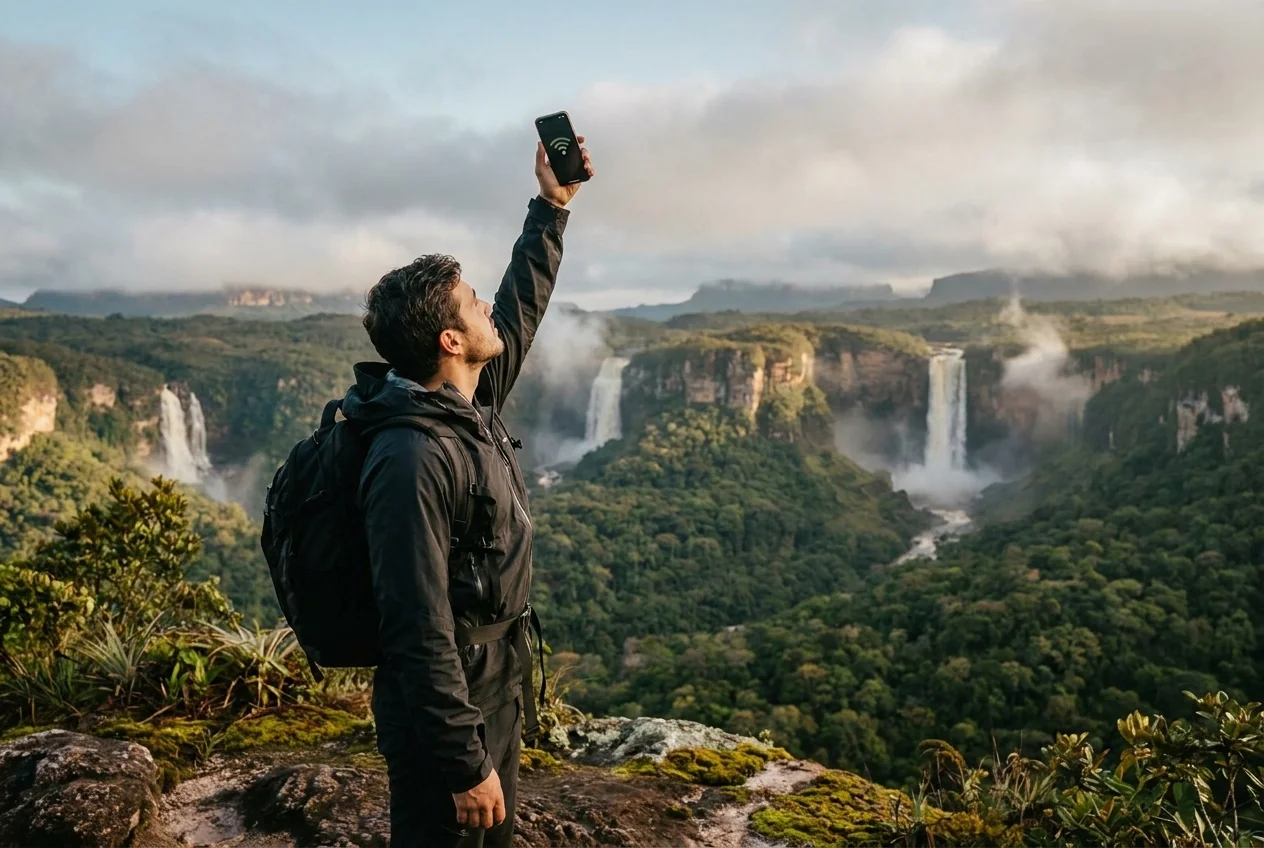
One of the first things travelers to Angel Falls need to accept is that for part of the trip, you will be completely offline. There is no cell tower at the falls, no signal on the river, and only patchy connectivity in Canaima village. For some people that is the point; for others it is a logistical problem to plan around, especially if you are traveling solo or need to stay reachable. This guide explains exactly where you can and cannot connect, how to prepare, what SIM and eSIM options exist, and how to handle being unreachable in one of the most remote places on the continent.
Where You Can and Cannot Connect
Connectivity in Venezuela drops off sharply as you move from cities toward Canaima. In Caracas and larger towns like Ciudad Bolivar, you can generally get mobile data and find wifi in hotels and cafes, though speeds and reliability vary. This is where you handle anything that needs the internet.
In Canaima village, connectivity is limited to patchy at best. Some posadas or lodges may offer intermittent wifi or you may catch a weak signal, but you should not count on it. Treat any connection there as a bonus, not a plan.
On the river journey and at the falls camp, there is no signal at all. For the two to three days of the core expedition you are entirely offline, with no way to call, message, or browse. This is the reality for everyone who visits, so build your plans and expectations around genuine disconnection during that stretch.
Plan to Go Offline
The most useful mindset shift is to plan for disconnection rather than fight it. Assume you will be unreachable for the core days of the trip and set everything up so that is fine. Tell family and colleagues in advance exactly when you expect to be offline and when you will next be in contact.
Download everything you might need before you lose signal: offline maps, your itinerary, booking confirmations, translation tools, entertainment for the evenings, and any reference material. Once you leave Ciudad Bolivar, you cannot pull anything new from the internet.
Handle time-sensitive matters, banking, work, messages, before you head into the jungle. The goal is to arrive at the falls owing nothing to the connected world, so the days offline feel like freedom rather than anxiety. Many travelers find the forced disconnection one of the most restorative parts of the whole experience.
Telling People Back Home
Give family or friends a clear window when you will be out of contact and reassure them in advance that silence is expected, not a sign of trouble. Share your operator's contact details as an emergency channel. A little communication before you disappear prevents worried messages and unnecessary alarm while you are happily offline at the falls.
SIM Cards and eSIM Options
For the connected parts of your trip, in cities and towns, you have a few ways to get data. A local Venezuelan SIM card can work, but buying and registering one as a foreigner can be fiddly, and coverage still will not reach Canaima. For many travelers, an international roaming plan or a travel eSIM is simpler for the urban portions.
An eSIM you set up before you travel lets you land with data already working in areas that have coverage, without hunting for a shop. Check that your chosen provider actually covers Venezuela and understand that no plan, local or international, will give you signal in the roadless interior.
Whatever you choose, the honest bottom line is that connectivity is for cities only. Do not overinvest in a data solution expecting it to help at the falls, because nothing works there. Set up something reliable for Caracas and Ciudad Bolivar, and treat the rest of the trip as offline by design.
Managing Expectations on Speed
Even where you do have a connection, speeds in Venezuela can be slow and unreliable by international standards. Large downloads, video calls, and heavy uploads may be frustrating. Do essential online tasks when you have a solid connection in a city, and do not rely on being able to handle bandwidth-hungry work from the road.
Navigation and Useful Offline Tools
With no data in the interior, offline tools earn their keep. Download offline maps of your regions before you go, since you cannot load them later, though remember that the falls trip is guided and you will not be navigating yourself. Offline maps are most useful for the city portions and for general orientation.
An offline translation app is handy, since English is limited outside tourism and your guides may speak mainly Spanish and Pemon. Downloading the relevant language pack in advance means you can communicate basic needs even with no signal.
Beyond that, load your phone with downloaded books, music, podcasts, or shows for the quiet camp evenings, and keep digital copies of your documents, tickets, and confirmations stored offline. A phone prepared this way remains a useful tool in the jungle even without a single bar of signal.
Keeping Documents Offline
Store offline copies of your passport, yellow fever certificate, insurance policy, bookings, and your operator's contacts, both on your phone and on paper sealed in your dry bag. When you cannot reach the cloud, these local copies are what you rely on. Photograph everything important before you lose signal in Ciudad Bolivar.
Power: Keeping Devices Alive
Staying connected where you can, and using your phone as a camera and offline tool where you cannot, both depend on power, which is itself unreliable in Canaima. Electricity in the village runs on generators or solar and can cut out, and there is no power at all at the river camp beyond what your team carries.
A good power bank, ideally a high-capacity one, is essential. Charge it and all your devices fully in Ciudad Bolivar, the last place with dependable power, and ration your usage on the trip. Airplane mode dramatically extends battery life when there is no signal to chase anyway.
Bring the right cables and consider a small solar charger if you are staying out longer. Protect all your electronics in your dry bag against the constant moisture. Managing power well is what lets your phone keep working as a camera and reference through the days when it cannot connect to anything.
Battery-Saving Habits
Switch to airplane mode as soon as you lose signal, dim your screen, close background apps, and use the phone deliberately rather than idly. These habits can double how long a charge lasts. Since recharging is uncertain in the jungle, treat every percent of battery as a resource to spend carefully across the offline days.
Embracing the Disconnection
For all the logistics, the offline stretch of the Angel Falls trip is worth reframing as a feature rather than a bug. Being genuinely unreachable for a few days, with no notifications, no email, and nothing to scroll, is a rare experience in modern life, and many travelers describe it as one of the trip's unexpected gifts.
Without a screen pulling at your attention, you notice more: the sound of the river at night, the scale of the tepuis, conversations with your guides and fellow travelers. The falls demand presence, and disconnection helps you give it.
So prepare thoroughly, tell people you will be offline, set up your devices for the practical tasks, and then let go. The connected world will still be there when you fly back to Ciudad Bolivar. The days at Angel Falls are a chance to be fully somewhere, which is exactly what a place like this deserves.
A Realistic Contact Plan
If you truly must stay reachable for work or family reasons, be honest that this trip does not allow it during the core days, and plan accordingly, perhaps by shortening your offline stretch or choosing an itinerary with more village time. For nearly everyone else, a simple message home before and after the falls is all the contact plan you need.
Emergency Communication in the Interior
Being offline raises a fair question: what happens in an emergency when there is no signal at all? The answer is that your safety net is your operator and guides, not your phone. Reputable operators running trips into Canaima have their own ways of coordinating and calling for help, and your Pemon guides know the region and the routines for reaching assistance.
Before you go offline, understand your operator's emergency arrangements. Ask how they communicate from the field and what the plan is if someone is hurt or falls ill on the river. Leave their contact details with family at home as the channel to reach you or get information while you are unreachable.
Do not rely on carrying your own satellite device as a substitute for a well-run tour, though experienced independent travelers sometimes do bring one. For nearly everyone, the right approach is to travel with a trustworthy operator, know their emergency plan, and accept that your personal phone is a camera and offline tool in the interior, not a lifeline.
Questions to Ask Your Operator
Before the trip, ask your operator how they call for help from the river and camp, how long an evacuation realistically takes, and what they expect of you in an emergency. Knowing the answers gives you confidence to disconnect and helps your family understand the safety setup. A good operator answers these questions clearly and without hesitation.