Angel Falls with Kids: A Family Travel Guide
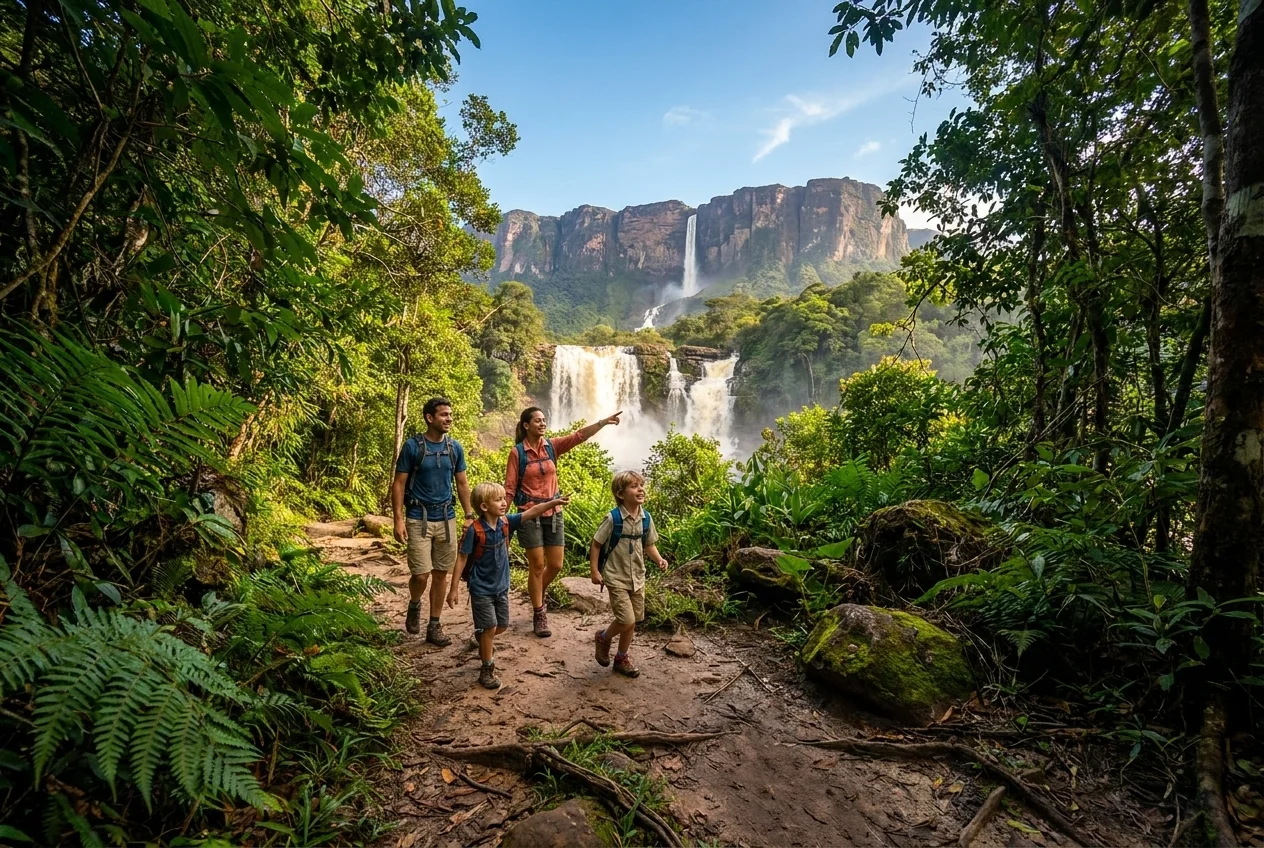
Your 8-year-old will remember standing at the base of Angel Falls for the rest of their life. The spray hitting their face, the roar echoing off the canyon walls, the sheer impossibility of water falling 979 meters from a flat-topped mountain. Families do visit Angel Falls successfully, but it requires more planning than a typical vacation. This guide covers exactly what you need to know: which ages work for which activities, how to modify the standard itinerary for children, and the practical health and logistics details that make or break a family trip.
Age Recommendations by Activity
Not every Angel Falls experience suits every age group. Here is an honest breakdown of what works at different stages.
For the classic motorized canoe trip up the Carrao and Churun rivers (the standard 3-day Angel Falls excursion), the minimum recommended age is 6 to 7 years old. The journey involves 4 to 5 hours in a dugout canoe each way, with some sections requiring passengers to exit and walk around rapids. Children need to sit relatively still in the canoe, wear a life jacket the entire time, and handle basic trail hiking (about 90 minutes each way to the base viewpoint). Kids under 6 will find the long boat ride exhausting and the hiking challenging.
Helicopter tours are suitable for children of virtually any age, including toddlers. The flight from Canaima to Angel Falls takes roughly 35 to 45 minutes and provides spectacular aerial views without any physical demands. This is the best option for families with children under 6 or kids who are not strong hikers.
The Canaima Lagoon area, including walks to Sapo and Sapito waterfalls, works well for ages 4 and up. The trails are short (15 to 30 minutes), and walking behind the curtain of Sapo Falls is a highlight that kids of all ages find thrilling.
For the Mount Roraima trek (a separate, more demanding adventure), the minimum recommended age is 12 to 14, depending on your child's hiking experience and fitness level. See our Mount Roraima trek guide for details.
Family-Friendly Itinerary Modifications
The standard Angel Falls itinerary (3 days, 2 nights) can be adapted for families. The key modifications involve pacing, comfort, and contingency planning.
Consider booking a 4-day package instead of 3 days. The extra day allows you to split the river journey with a longer rest stop, giving kids more time to swim, explore, and decompress between boat segments. Some operators offer a "family pace" option that includes additional beach stops along the river where children can play in the shallows.
Request a private tour rather than joining a group departure. With a private guide, you control the pace entirely. If your child needs an extra bathroom break, a longer lunch, or wants to spend more time at a swimming spot, you are not holding up 10 other travelers. Private tours cost roughly 30 to 50 percent more than group rates, but for families with young children, the flexibility is worth every dollar.
Build in a full day at Canaima Lagoon before or after the Angel Falls trip. This gives kids a chance to acclimate to the environment, play in the lagoon, visit the smaller waterfalls, and burn off energy before the longer river journey. Many families report that this buffer day made the overall trip significantly smoother.
For detailed route planning, see our complete guide to visiting Angel Falls.
Helicopter Tours: The Kid-Friendly Alternative
If your children are under 6 or your family simply prefers comfort over adventure, a helicopter tour to Angel Falls is the best option. You get the views without the physical demands of the river trip.
Helicopter tours depart from Canaima and fly directly over the falls, often circling multiple times at different altitudes. The flight takes 35 to 45 minutes and some tours include a brief landing near a viewpoint (weather permitting). Children are mesmerized by the aerial perspective, and the shorter duration means no meltdowns from exhaustion.
Availability depends on weather and demand. Helicopter tours operate most reliably from June through November when water levels are high and the falls are at their most dramatic. Prices range from $250 to $350 per person, with children under 2 sometimes flying free on a parent's lap (confirm with your operator).
The trade-off is that you miss the jungle immersion of the river trip. You will not hike to the base of the falls, feel the spray, or swim in the natural pools. For many families, the ideal approach is a helicopter overflight for the younger kids combined with the full river trip for older children. See our helicopter tours guide for booking details.
One practical note: helicopter tours are weather-dependent and can be cancelled with short notice. Build flexibility into your schedule so you have at least one backup day if the first attempt is grounded by clouds.
What Kids Actually Love About the Trip
Parents often worry about whether their children will appreciate Angel Falls the way adults do. The waterfall itself is impressive to kids, but it is not necessarily the highlight of their trip. Here is what children consistently rave about.
The canoe ride is an adventure in itself. Sitting in a motorized dugout canoe, watching the jungle pass by, spotting birds and occasionally a caiman along the riverbank, this is Indiana Jones territory for kids. Most children are captivated for the first 2 to 3 hours. After that, boredom can set in, so bring a small daypack of entertainment (see tips below).
Walking behind Sapo Falls is the single most popular activity with children. You literally walk through a cave passage behind a curtain of falling water. You get soaked. Kids scream with delight. It is the kind of visceral, full-body experience that no screen can replicate.
Swimming in the river pools and lagoons during rest stops is another highlight. The water is tea-colored (stained by tannins from vegetation) but clean. Kids can splash, float, and explore shallow areas under the watch of guides who know the safe swimming zones.
The Pemon guides themselves often become heroes to children. Many guides are young, athletic, and genuinely enjoy engaging with kids. They will point out animals, show children how to spot tracks, and sometimes teach basic Pemon words. This cross-cultural interaction sticks with kids long after the trip.
Health and Medical Preparation for Kids
Medical preparation is more important for family trips than for adult-only travel. Canaima is remote, with no hospital and only a basic medical dispensary. The nearest hospital is in Ciudad Bolivar, roughly 1 hour away by small plane.
Consult a travel medicine specialist at least 6 weeks before your trip. Standard vaccinations for Venezuela include hepatitis A and B, typhoid, and yellow fever. Yellow fever vaccination is recommended for Bolivar state (where Canaima is located) and is required if you are arriving from or transiting through certain other countries. Children as young as 9 months can receive the yellow fever vaccine.
Malaria prophylaxis is recommended for travel in Bolivar state. Options for children include atovaquone-proguanil (Malarone), which is approved for kids weighing at least 5 kg (11 lbs). Start the medication 1 to 2 days before arrival and continue for 7 days after leaving the malaria zone. Your pediatrician can advise on the appropriate dosing.
Bring a comprehensive first-aid kit that includes children's versions of: anti-diarrheal medication, oral rehydration salts (critical for dehydration from heat or stomach bugs), antihistamines, pain reliever and fever reducer, insect repellent with 20 to 30 percent DEET (or picaridin as an alternative for younger children), and sunscreen rated SPF 50 or higher.
For a complete packing checklist, refer to our what to pack guide.
Food, Accommodation, and Keeping Kids Entertained
Food in Canaima is simple but generally kid-friendly. Meals typically include rice, beans, grilled chicken or fish, plantains, and fresh fruit. Most posadas can accommodate basic dietary needs if you communicate them in advance. Picky eaters should bring backup snacks from home: granola bars, dried fruit, crackers, and peanut butter travel well in the heat.
During the river trip, meals are prepared by the guides at camp. Expect freshly caught fish, grilled over an open fire, with rice and vegetables. Kids usually find this exciting rather than off-putting, especially when they can watch the guides catch and prepare the fish.
Accommodation in Canaima ranges from basic to comfortable. Most posadas offer private rooms with beds, mosquito nets, and sometimes air conditioning. During the river trip, you sleep in hammocks under a thatched-roof shelter (churuata). Most children adapt to hammocks surprisingly well, though bringing a familiar blanket or stuffed animal can help with bedtime transitions.
For entertainment during boat rides and downtime, pack a small waterproof bag with: a compact set of playing cards, a sketchbook and colored pencils, binoculars for bird and wildlife spotting, a waterproof camera or phone case so kids can take their own photos, and a field guide to Venezuelan wildlife (even a printed PDF works). Avoid tablets and electronic games. This is an opportunity for kids to engage with the natural world around them, and screen time will drain batteries you cannot recharge on the river.