Canaima Lagoon and Its Waterfalls: A Day Trip Guide
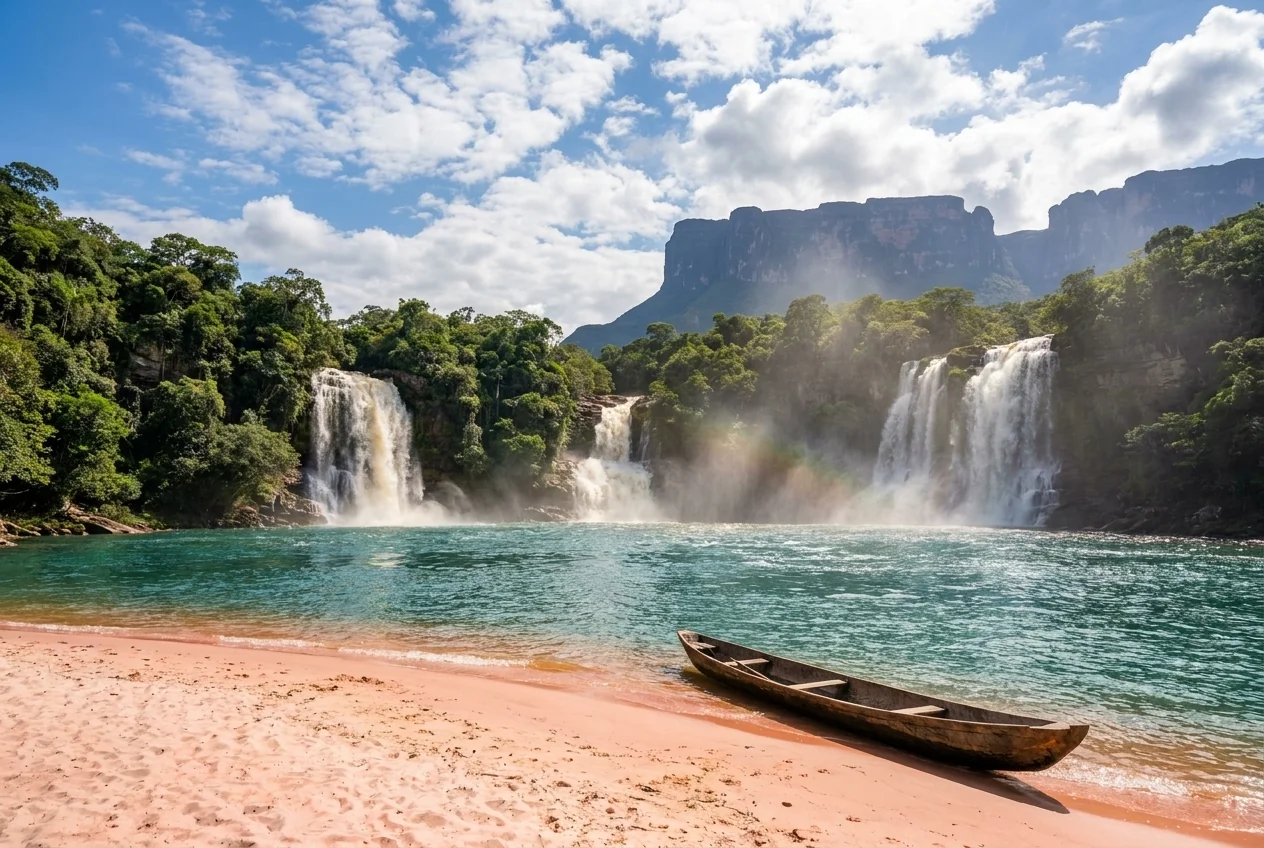
Before you ever board a canoe for Angel Falls, Canaima Lagoon stops you in your tracks. A wide, tannin-stained lagoon framed by pink-sand beaches with seven waterfalls thundering along its far edge, it looks like something a film set designer would be told to make less dramatic. Most travelers pass through Canaima village on their way to Angel Falls and treat the lagoon as a pleasant backdrop. That is a mistake. The lagoon and its waterfalls deserve at least a full day of exploration, and this guide shows you how to make the most of it.
The Lagoon: First Impressions and Geography
Canaima Lagoon sits at the heart of Canaima village, the small settlement that serves as the gateway to Angel Falls and much of Canaima National Park. The lagoon is formed by the Carrao River broadening into a wide basin before continuing downstream. Its water is the color of strong tea, stained by tannins from decomposing vegetation upstream. This is completely natural and the water is clean.
The lagoon's most striking feature is the line of waterfalls along its western and southern edges. From certain vantage points (particularly the pink-sand beach near the village), you can see all seven falls at once, each pouring over a sandstone lip into the lagoon below. The combined roar is audible from anywhere in the village.
The sand on the beach is genuinely pink, a result of quartz and feldspar minerals eroding from the surrounding sandstone. It is one of the few inland pink-sand beaches in the world. The contrast between the pink sand, dark water, and white waterfalls is extraordinary and photographs well at almost any time of day.
The Seven Waterfalls: A Guide to Each
The lagoon's seven waterfalls vary in size and character. Not all are named consistently on every map, and some names vary between Pemon and Spanish usage. Here are the ones you should know.
Salto El Hacha
The tallest and most visually dramatic waterfall on the lagoon, Salto El Hacha drops approximately 40 meters in a single curtain of water. You can approach it by canoe and disembark on rocks at its base, where the spray creates a permanent mist. The pool at its foot is deep enough for swimming, though the force of the water near the falls is strong. This is the waterfall most postcards feature, and it deserves the attention.
Salto Ucaima
A broader, shorter falls that stretches wide across the sandstone shelf. Salto Ucaima is less dramatic in height than El Hacha but impressive in volume, especially during the rainy season when the entire shelf disappears under a sheet of rushing water. It is visible from the village beach and makes a powerful backdrop for photos.
Salto Golondrina
Named after the swallows (golondrinas) that nest in the rock behind the falling water, Salto Golondrina is a narrow falls that drops into a rocky pool. The birds darting through the spray at dawn and dusk are a memorable sight. Access is by canoe, and your Pemon guide will typically include this on a lagoon tour.
Salto Wadaima and the Others
Salto Wadaima and the remaining falls are smaller but contribute to the panoramic wall of water visible from the beach. During the wet season (June to November), all seven falls run at full volume and the collective force creates visible waves across the lagoon surface. In the dry season, some of the smaller falls reduce to trickles, but the major ones remain impressive year-round.
Swimming in the Lagoon
Yes, you can swim in Canaima Lagoon, and you should. The tannin-stained water is warm (typically 24-27C), clean, and surprisingly soft on your skin. The pink-sand beach near the village slopes gently into the lagoon, making it accessible for all swimming abilities.
A few safety notes are important. The lagoon has currents, particularly near the waterfalls where water flows through channels between rocks. Do not swim close to the falls unless your guide confirms it is safe at current water levels. During the rainy season, higher water volumes increase current strength.
The best swimming spots are the beach area itself (calm, shallow, ideal for families), the pool at the base of Salto El Hacha (deep, swimmable, exhilarating), and a natural pool accessible by a short trail near Salto Golondrina. Your Pemon guide will know which spots are safest on the day you visit, as conditions change with water levels.
There are no changing rooms, showers, or lifeguards. Wear your swimsuit under your clothes or change behind the vegetation (locals are discreet about this). Bring water shoes if you have them; the rocks near the falls are slippery.
Canoe Tours on the Lagoon
A canoe tour of the lagoon is the best way to see all the waterfalls up close. Motorized wooden canoes (curiaras) depart from the village beach with Pemon guides and hold 4 to 8 passengers. A full lagoon circuit takes 2 to 3 hours and includes stops at the base of Salto El Hacha, Salto Golondrina, and at least one swimming spot.
Most Angel Falls tour packages include a lagoon canoe tour as part of your first or last day in Canaima. If yours does not, you can arrange one independently through any Pemon guide in the village for approximately $15-25 per person. The morning tour (departing around 8 AM) has the best light and fewer other boats.
The canoe ride itself is part of the experience. Your guide navigates through rock channels, past small islands, and under overhanging trees. The lagoon is large enough that even with several canoes operating, you rarely feel crowded. On clear days, the tepuis (tabletop mountains) visible in the distance complete a panorama that justifies every hour of travel it took to reach Canaima.
The canoe tour also provides the approach to Salto Sapo, the famous waterfall you can walk behind. This excursion is usually a separate trip or an extension of the lagoon tour, so confirm with your guide whether it is included.
Best Time of Day and Photography Tips
Morning light (6:30 to 9:00 AM) is best for photographing the waterfalls, as the sun illuminates the falls from the east while the lagoon remains in softer light. The contrast between the white water and dark lagoon is at its peak. By midday, the light is harsh and flat, washing out the falls.
Late afternoon (4:00 to 5:30 PM) brings warm golden light that hits the pink sand and creates long reflections on the water. Sunset from the beach, with the silhouettes of the falls against an orange sky, is one of the most photographed scenes in Canaima.
For the waterfalls themselves, bring a polarizing filter if you use a dedicated camera. It cuts through the mist and glare on the water surface. A fast shutter speed (1/500 or higher) freezes individual water droplets in the spray; a slow shutter speed (1/4 second or longer, with a tripod) creates the smooth, silky water effect. Both work well here.
Your phone will get wet on the canoe tour. A waterproof phone case (the pouch type with a lanyard) costs $10-15 and saves you from the single most common equipment loss in Canaima. Several travelers each week drop phones into the lagoon from canoes.
The panoramic view from the beach showing all seven falls in a single frame works best with a wide-angle lens (16-24mm equivalent). For individual waterfall portraits, a 50-100mm focal length isolates each one from the others.
How the Lagoon Fits into Your Canaima Trip
Most visitors to Canaima arrive for a 3 to 5 day trip focused on Angel Falls. The lagoon is right at your doorstep in Canaima village and does not require any additional transport to reach. Here is how it typically fits into a visit.
If you arrive in Canaima by midday (common for morning flights from Ciudad Bolivar), the afternoon is perfect for a lagoon canoe tour and swimming. This serves as both an introduction to the area and a way to adjust to the environment before the longer Angel Falls river journey the next day.
Alternatively, the lagoon makes an excellent final-day activity. After returning from Angel Falls (usually by mid-morning on your last full day), spend the afternoon swimming, exploring the falls, and taking photographs in the golden hour light before your departure the next morning.
Do not treat the lagoon as filler between flights. Give it at least 4 to 5 hours of unhurried time. Swim, walk the beach, take the canoe tour, sit on the sand and watch the falls. The lagoon is not the warm-up act for Angel Falls. It is a destination in its own right, and travelers who rush through it consistently say they wish they had lingered.