Salto Sapo: Walking Behind a Waterfall in Canaima
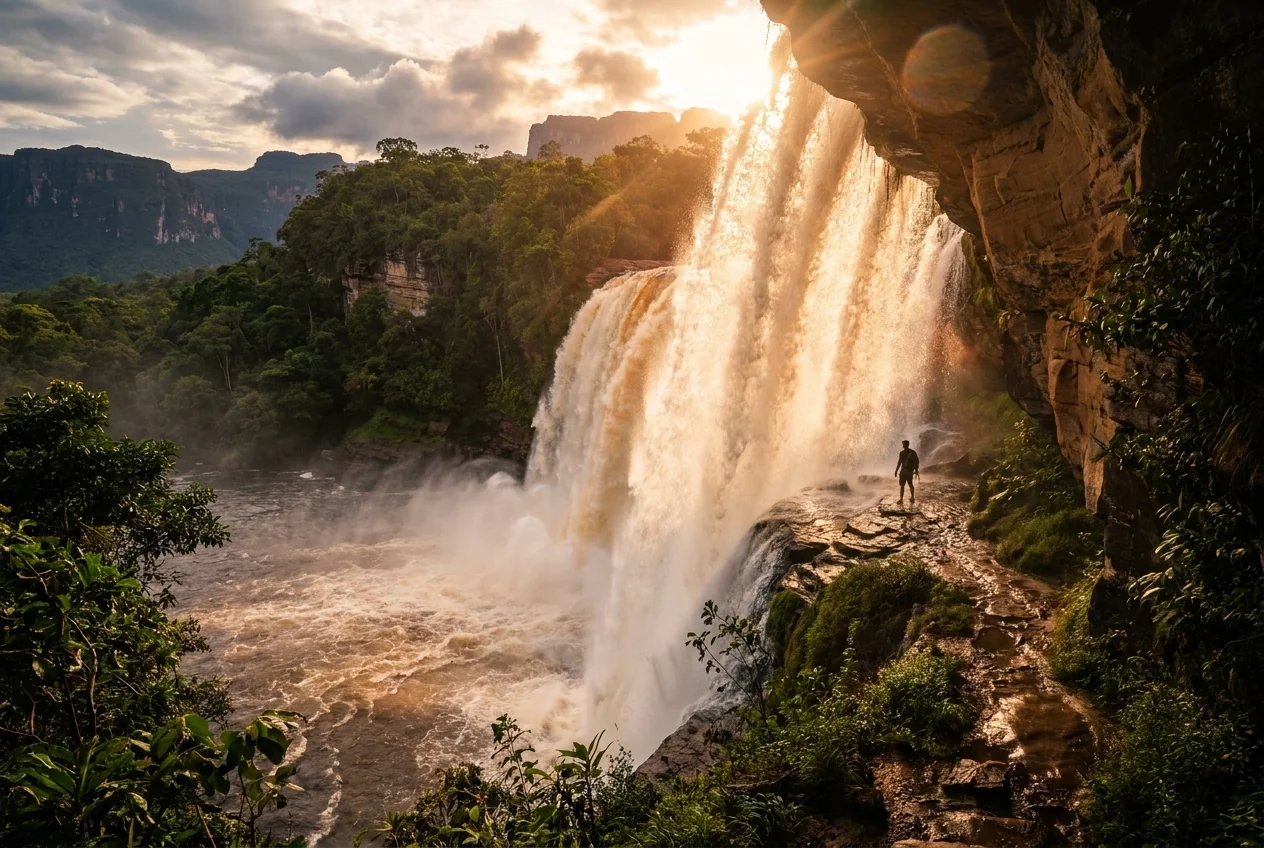
There are very few places on Earth where you can walk behind a waterfall. Salto Sapo in Canaima National Park is one of them, and it delivers an experience that no photograph can fully capture. A 20-meter-wide curtain of water crashes over a sandstone ledge while you walk along a narrow rocky path directly behind it, the roar drowning out every other sound, the spray soaking you completely within seconds. It is one of the most visceral encounters with moving water you will ever have. This guide walks you through what to expect, what to bring, and how to make the most of this half-day excursion.
What Makes Salto Sapo Unique
Salto Sapo (which translates to "Toad Falls" in Spanish) is not the tallest or most powerful waterfall in Canaima. What makes it exceptional is the geology. The falls drop over a wide sandstone ledge that has eroded to create a natural overhang, forming a corridor between the rock face and the falling water. This corridor is wide enough to walk through, and the path behind the falls stretches for approximately 100 meters.
The waterfall is roughly 20 meters wide and drops about 20 meters. During the rainy season (June to November), the curtain of water is thick and continuous, with no gaps. During the dry season, the flow reduces and you can sometimes see through the water curtain to the lagoon beyond. Both experiences are remarkable, though the wet season version is more dramatic.
Salto Sapo sits on the Carrao River system, accessible from Canaima Lagoon by canoe. It is part of the same waterfall complex that includes the seven falls visible from the Canaima village beach, but it requires a separate excursion to reach the walk-behind trail.
The Experience, Step by Step
The excursion begins with a canoe ride from Canaima village, crossing the lagoon toward the falls. The journey takes approximately 20 to 30 minutes, depending on water conditions and which landing point your guide chooses. As you approach, the sound grows from a distant hum to a wall of noise.
The Approach Trail
After the canoe lands on a rocky beach near the falls, you follow a short trail (about 10 to 15 minutes) through vegetation along the river bank. The trail is uneven, with exposed roots and slippery rocks. It is not technically difficult, but it requires reasonable footing. Your Pemon guide leads the way and will point out the best places to step. The spray begins before you reach the falls, and by the time you see the water curtain ahead, your clothes are already damp.
Walking Behind the Curtain
The path behind the waterfall runs along a narrow ledge between the rock face and the falling water. In places, the ledge is barely a meter wide. The water crashes down less than an arm's length from your face. You cannot hear anything except the roar. You cannot see more than a few meters ahead through the spray. You will be completely, utterly, thoroughly soaked within the first 10 seconds.
The walk behind the curtain takes about 10 to 15 minutes at a careful pace. The footing is rocky and wet, so move slowly and use the rock wall for balance. Your guide will pause at several points where the view through the water is particularly striking. At the midpoint, there is a slight alcove where you can stand and look straight through the curtain of water at the lagoon beyond.
The Other Side
You emerge on the far side of the falls soaked to the bone and grinning. Most groups pause here to catch their breath, wring out their clothes, and take photos before the return walk. Some guides lead you back behind the falls (yes, you get soaked again), while others take a trail around the outside. Ask your guide in advance which route the return will follow.
Physical Requirements and Safety
Walking behind Salto Sapo does not require special fitness or climbing skills. Any reasonably mobile person who can handle uneven terrain and slippery rocks will manage it. Children over about 8 years old can do it with a parent's hand. The trail is not steep, and the walk behind the curtain is on relatively flat ground.
That said, the force of the water is real. The spray hits you hard, and if you step too close to the edge of the curtain, the falling water can push you off balance. Stay close to the rock wall and follow your guide's path exactly. During the peak rainy season, guides may shorten the walk or adjust the route if water volume makes certain sections unsafe.
There are no railings, ropes, or safety equipment. This is a natural environment, not a theme park attraction. The Pemon guides who lead this walk have done it hundreds of times and know every rock. Trust their judgment about pace and positioning.
People with serious mobility issues, inner ear conditions affecting balance, or extreme fear of water should skip this excursion. For everyone else, it is one of the highlights of any Canaima trip.
What Will Get Wet (Answer: Everything)
This is not a "you might get a little damp" situation. You will be soaked as if you jumped into a swimming pool fully clothed. Every item on your body, in your pockets, and in any bag that is not waterproof will be drenched. Plan accordingly.
Wear quick-dry clothing (synthetic athletic wear is ideal). Cotton takes hours to dry in the humidity and will leave you cold and uncomfortable. Leave your cotton t-shirt and jeans at the posada.
Wear water shoes or sport sandals with heel straps (Teva, Keen, or similar). Flip-flops will come off in the current. Hiking boots will take two days to dry.
Leave everything non-essential in the canoe or at your posada. Your wallet, paper documents, regular sunglasses, and non-waterproof watch should stay behind. Bring only what you are prepared to get fully submerged.
For your phone, you have two options: leave it in the canoe (safest) or use a properly sealed waterproof pouch with a lanyard around your neck. Do not attempt to carry your phone in a pocket or regular bag. The spray is not a mist; it is a deluge.
Photography Behind the Falls
Getting good photos behind Salto Sapo is challenging but possible. The main obstacles are the constant spray (which covers your lens within seconds), low light (the curtain of water blocks most sunlight), and the fact that you are trying to operate a camera while being hammered by water.
A waterproof action camera (GoPro or similar) is the best tool for this job. Mount it on a chest or head strap so you can use both hands for balance. Wide-angle mode captures the scale of the water curtain and the narrow path. Shoot video rather than photos; you can pull stills from video later, and the video captures the sound and motion that make this experience special.
If you bring a waterproof phone pouch, the touchscreen may not respond well through wet plastic. Set your camera to video mode before you enter the spray zone and let it run. You can edit later.
For a dedicated camera with waterproof housing, use a wide-angle lens (16-24mm), set ISO high (1600-3200 to compensate for low light), and use the fastest aperture your lens allows. Autofocus struggles in the spray, so pre-focus manually to about 1 meter.
The most dramatic photos come from looking outward through the water curtain, with the bright lagoon visible as a blurred backdrop behind the sheets of falling water. Time this shot for when your guide pauses at the midpoint alcove.
Salto Sapo vs. Salto El Hacha
Visitors sometimes ask whether they need to do both the Salto Sapo walk and the Salto El Hacha visit, or whether one substitutes for the other. They are completely different experiences.
Salto El Hacha is the taller, more visually imposing waterfall on the lagoon. You approach it by canoe, stand at its base, and swim in its pool. It is a classic waterfall experience: spectacular to look at, great for photos, refreshing to swim near. You view it from the outside.
Salto Sapo is about being inside the waterfall. You do not stand back and admire it. You walk through it, feel it on your body, hear it consume every other sound. It is less photogenic from a distance but far more physically immersive.
Do both if your schedule allows. Most Canaima itineraries include both as separate excursions. If you must choose one, Salto Sapo is the more unique experience (you can see tall waterfalls in many countries, but walking behind one is rare). See our Canaima Lagoon waterfalls guide for the full rundown on all the lagoon falls, including El Hacha.
The best approach is to visit El Hacha on your lagoon canoe tour and do the Salto Sapo walk as a separate half-day excursion. This gives each waterfall the attention it deserves.