Canaima National Park: The Complete Visitor's Guide
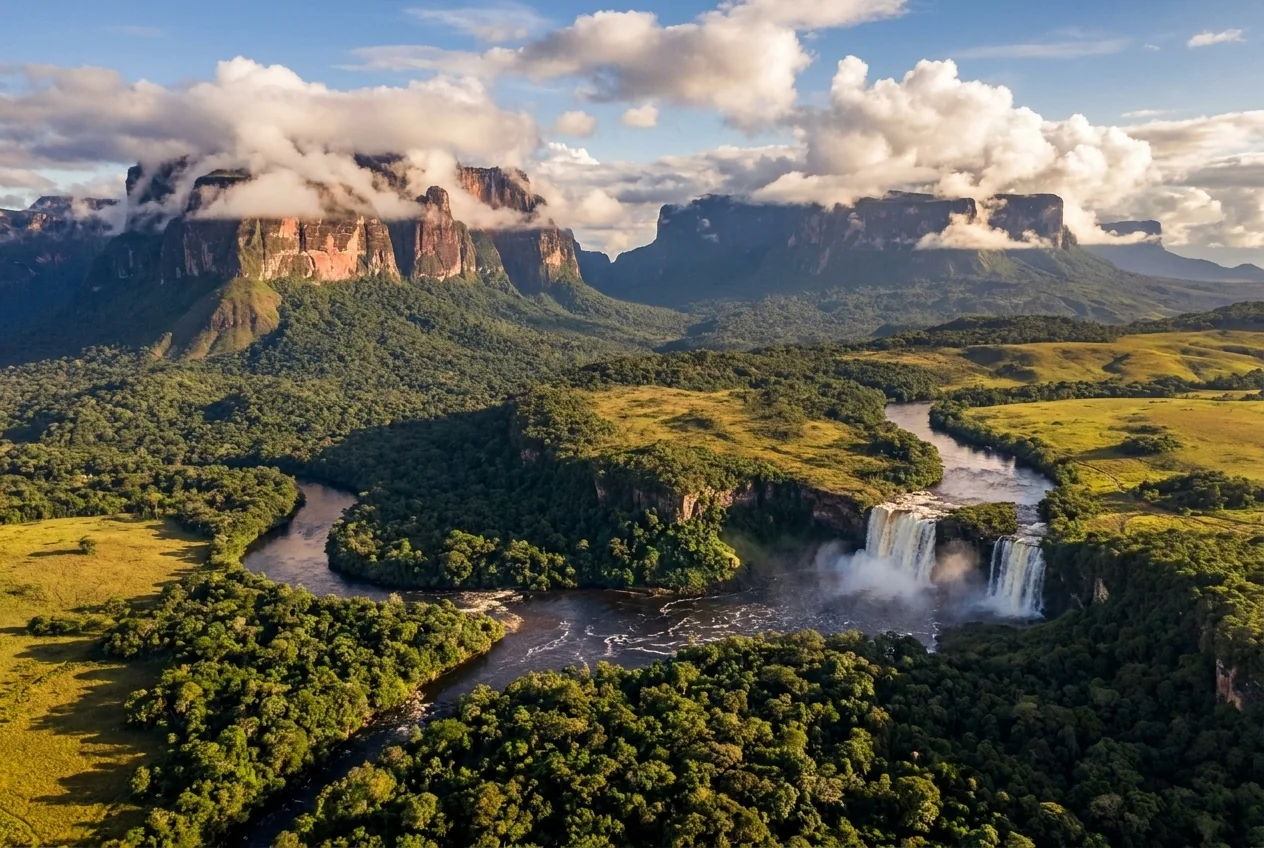
Canaima National Park covers 30,000 square kilometers of southeastern Venezuela, roughly the size of Belgium. It was designated a UNESCO World Heritage Site in 1994 and contains the highest concentration of table-top mountains (tepuis) on Earth, the world's tallest waterfall, and some of the oldest geological formations on the planet, dating back 2 billion years. This guide covers everything you need to plan a visit: what to see and do, how to get there, where to stay, when to go, and what the experience is actually like on the ground.
Understanding the Park: Geography and Geology
Canaima sits on the Guiana Shield, one of the oldest geological formations on Earth. The park's defining features are its tepuis, flat-topped sandstone mountains that rise abruptly from the surrounding jungle and savanna. There are over 100 tepuis in the park, with Auyantepui (the source of Angel Falls) being the largest at 700 square kilometers of summit area.
The park divides roughly into two zones. The western section centers on Canaima Lagoon and Angel Falls, accessible by air from Ciudad Bolivar. The eastern section encompasses the Gran Sabana highlands and is accessible by road (Route 10) from Ciudad Bolivar to the Brazilian border. Most visitors focus on the western zone, but the eastern Gran Sabana offers its own extraordinary landscapes.
The rivers that flow off the tepuis carry tannins from the vegetation, giving them a distinctive tea-colored appearance. This is not pollution. It is natural organic compounds that also make the water slightly acidic. The lagoons and pools throughout the park have this characteristic amber tint, which creates striking visual contrasts against white sand beaches and red-brown rock.
What to See and Do
The park has enough to fill weeks, but most visitors concentrate on a handful of signature experiences that can be covered in 4 to 7 days. These are the highlights that justify the journey.
Angel Falls (Salto Angel)
The world's tallest uninterrupted waterfall drops 979 meters from the summit of Auyantepui. Reaching the base requires a full-day motorized canoe trip up the Churun River followed by a 90-minute jungle hike. The standard visit is a 3-day/2-night tour from Canaima village. During peak water flow (July to October), the falls produce a permanent mist cloud visible from kilometers away. Read our complete Angel Falls guide for the full breakdown.
Canaima Lagoon
The lagoon sits at the base of Canaima village and features seven waterfalls cascading over a wide rock shelf into a broad, tea-colored pool. Hacha, Golondrina, Ucaima, and Wadaima are the most accessible. You can swim in the lagoon (the water is safe, just tannin-stained), walk behind Salto El Sapo through a curtain of falling water, and take boat trips to the base of several falls. Most visitors spend a half-day to full day exploring the lagoon.
Salto El Sapo (Walk Behind the Waterfall)
This is one of the most unique waterfall experiences anywhere. A trail leads behind the curtain of Salto El Sapo, where you walk through the gap between the rock wall and the falling water. You will get soaked, the force of wind from the falls is intense, and the ground is slippery. Waterproof bags for your camera are essential. The walk takes about 20 minutes and is included in most Canaima Lagoon tours.
Isla Orquidea and River Trips
Boat tours from Canaima village explore the rivers feeding the lagoon, stopping at Isla Orquidea (Orchid Island) and various swimming holes. These shorter excursions fill the days before or after your Angel Falls trip and cost $20 to $50 per person. The river landscape is beautiful in its own right, with tepuis visible in every direction.
How to Get There
There are no roads to Canaima village. Access is exclusively by small aircraft. Charter flights depart from Ciudad Bolivar and Puerto Ordaz, taking approximately 70 minutes. Read our detailed transport guide for schedules, prices, and booking tips.
Most travelers fly into Caracas (Maiquetia International Airport), then take a domestic flight or bus to Ciudad Bolivar. From Ciudad Bolivar, charter flights to Canaima's small airstrip run in the morning, weather permitting. During peak season (July to October), flights operate daily. In shoulder and low seasons, flights may only run 2 to 3 times per week.
The eastern part of the park (Gran Sabana) is accessible by paved road. Route 10 from Ciudad Bolivar to Santa Elena de Uairen passes through spectacular park scenery. If you are combining Canaima with a Gran Sabana road trip, the two zones require separate transport arrangements, as there is no road connection between them within the park.
Where to Stay
Accommodation in and around Canaima falls into three categories, each with a different character and price point.
Posadas in Canaima Village
Canaima village has a dozen or so posadas (guesthouses) ranging from basic to comfortable. Expect simple but clean rooms, mosquito nets, shared or private bathrooms, and meals included or available for an extra charge. Prices run $40 to $120 per night. Posada Kusari, Campamento Parakaupa, and Campamento Canaima are among the more established options. Most posadas can arrange tours directly, which is often the most convenient way to book.
Jungle Camps Near Angel Falls
During the river trip to Angel Falls, you sleep at basic jungle camps along the Churun River. These are not hotels. You sleep in hammocks under thatched-roof shelters (churuatas), eat meals prepared over open fires, and use basic latrine facilities. The experience is part of the adventure. Bring a lightweight sleeping bag or sleep liner for comfort and a headlamp for navigating camp at night.
Lodges and Premium Options
A few higher-end lodges operate in the Canaima area, offering private rooms, better facilities, and premium tour packages. Waku Lodge and Campamento Canaima (the original camp founded by Jungle Rudy) provide the most comfortable options. Rates run $120 to $250 per night. Availability is limited, so book well in advance during peak season.
When to Visit
The best time to visit Canaima depends on what you prioritize. The park is open year-round, but conditions change dramatically between seasons.
The wet season (June to November) brings the most water to Angel Falls and the lagoon waterfalls. July through September sees the peak flow, when Angel Falls is at its most spectacular. The trade-off is more rain (expect at least one heavy downpour daily), muddier trails, higher humidity, and more mosquitoes. Read our seasonal guide for month-by-month conditions.
The dry season (December to April) offers clearer skies, less rain, and fewer bugs. However, Angel Falls may be reduced to a thin stream or completely dry by February and March. The lagoon waterfalls maintain better flow during dry season than Angel Falls does. If clear views from the air matter more to you than maximum water volume, dry season has the advantage.
The sweet spots are June (early wet season, good water flow with less intense rain) and November (late wet season, waterfalls still flowing as the rains taper off). These shoulder months offer the best balance of water volume and manageable weather.
Permits, Fees, and Park Rules
Canaima National Park charges an entrance fee of $40 per person and $20 per child, collected either at the Canaima airstrip on arrival or included in your tour package. Confirm with your tour operator whether the fee is included to avoid double-paying.
The park is managed by INPARQUES (Venezuela's national parks agency) and is home to the indigenous Pemon people, who have lived in this region for thousands of years. Park rules exist to protect both the environment and the communities that depend on it.
You are required to stay on marked trails, pack out all waste (including biodegradable items), and avoid disturbing wildlife. Campfires are only permitted in designated areas at jungle camps. Swimming is allowed in the lagoon and designated river pools, but ask your guide about current conditions and safety before entering the water, as currents near waterfalls can be strong.
Photography and Drones
Photography is welcome everywhere in the park for personal use. Professional or commercial photography and filming require a permit from INPARQUES, which must be arranged in advance through their Caracas office. Drones are not permitted in the park without special authorization from both INPARQUES and Venezuelan aviation authorities. In practice, obtaining drone permits is extremely difficult and time-consuming.
The Pemon People and Community Tourism
Canaima is not just a national park. It is the ancestral homeland of the Pemon people, one of Venezuela's largest indigenous groups. The Pemon have lived on and around the tepuis for millennia, and their traditional knowledge of the landscape, rivers, and trails is the foundation of every tour operation in the park.
Most tour guides, boat pilots, camp cooks, and posada operators in Canaima village are Pemon. When you book a local tour, your money goes directly into the community. The Pemon name for Angel Falls is Kerepakupai Meru ("waterfall of the deepest place"), and the name Canaima itself comes from the Pemon language.
Visitors should approach Pemon communities and cultural sites with respect. Ask before photographing people. Do not enter homes or community areas without invitation. If you are offered local food (cassava bread, smoked fish, or jungle fruits), accepting is both polite and an interesting culinary experience. Some communities offer cultural demonstrations of traditional crafts, music, and dance, which are worth attending if available during your visit.
Flora and Fauna Highlights
Canaima's biodiversity is extraordinary, driven by the range of ecosystems within the park: lowland jungle, highland savanna, riverine forest, and the unique summit environments of the tepuis. You will encounter wildlife throughout your visit, though the dense jungle makes some species easier to hear than see.
Birds are the most visible wildlife. Expect to see macaws (scarlet and blue-and-yellow), toucans, parrots, kingfishers, and dozens of hummingbird species. Along the rivers, watch for herons, cormorants, and the striking Guianan cock-of-the-rock, a bright orange bird that is the icon of Venezuelan birdwatching.
Mammals are harder to spot but present throughout the park. Howler monkeys make themselves known by sound (their calls carry for kilometers), and capuchin monkeys are frequently seen near Canaima village. Giant river otters inhabit some of the larger rivers, and tapirs, jaguars, and pumas live in the deeper jungle, though sightings are rare.
The tepui summits host unique plant communities found nowhere else on Earth, including carnivorous plants (sundews, pitcher plants), bromeliads, and orchids that have evolved in isolation for millions of years. You will not see the summit flora unless you trek to the top of a tepui (like Roraima), but the forests and savannas at lower elevations are rich with orchids, heliconias, and giant ferns.