The Pemon People: Guardians of the Tepuis
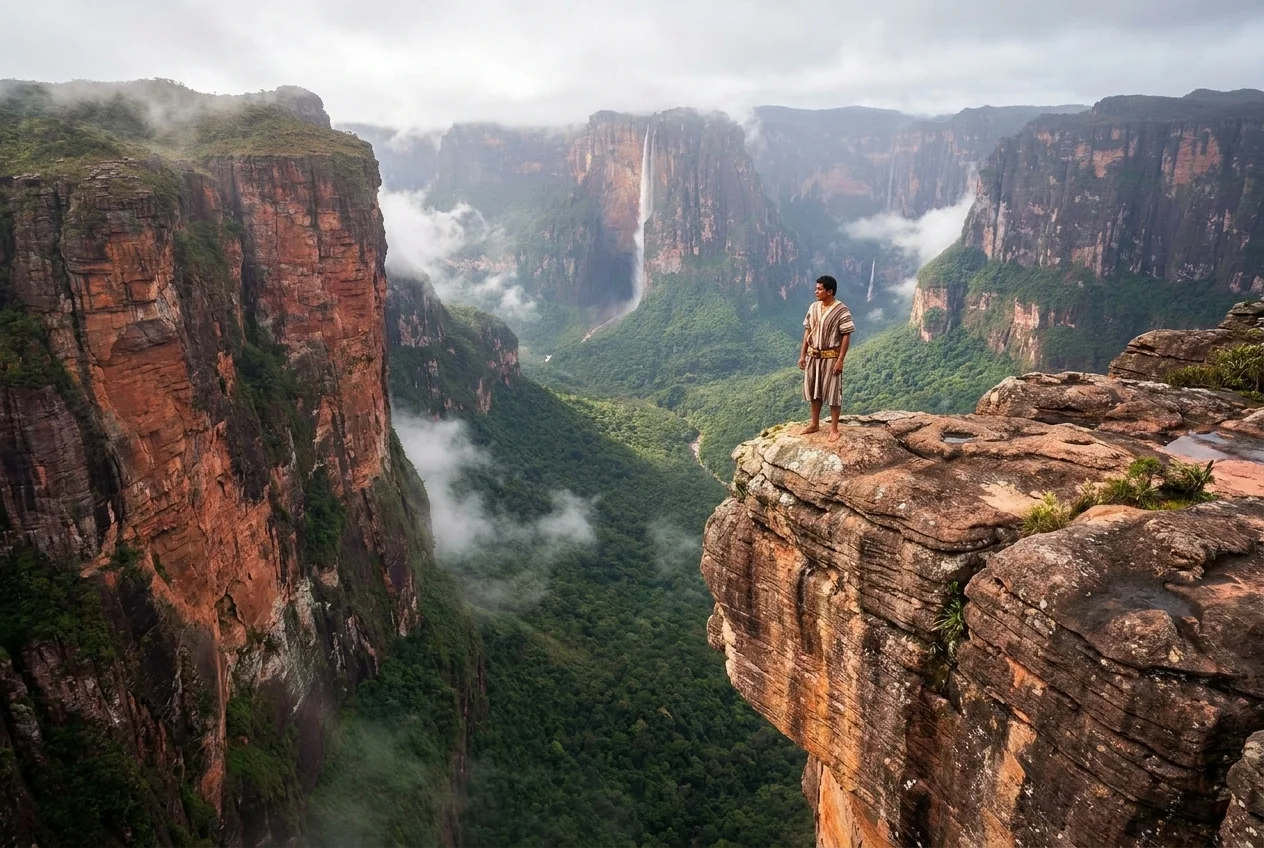
Long before Jimmy Angel crash-landed his plane on Auyantepui in 1937, the Pemon people had a name for the waterfall that tumbles 979 meters from the summit. They called it Kerepakupai Vena, meaning "waterfall of the deepest place." The name was not a casual label. It reflected a cosmology in which the tepuis are not just mountains but living entities, sacred spaces where the boundaries between the physical and spiritual worlds thin. Today, every visitor to Angel Falls is guided by Pemon hands, fed by Pemon cooks, and transported in Pemon canoes. Understanding who these people are changes the way you experience everything in Canaima.
Who the Pemon Are
The Pemon are a Carib-speaking indigenous people numbering approximately 30,000 individuals spread across southeastern Venezuela, western Guyana, and northern Brazil. The majority live in Venezuela's Bolivar state, which contains most of the Gran Sabana and Canaima National Park.
The Pemon are divided into three main subgroups, distinguished primarily by dialect and geographic location. The Taurepan live in the eastern Gran Sabana near the Brazilian and Guyanese borders, including the area around Mount Roraima. The Arekuna occupy the central Gran Sabana and parts of the Caroni River basin. The Kamarakoto live in the western portion of the national park, including the Canaima village area and the territory around Angel Falls. When you visit Canaima, your guides are almost certainly Kamarakoto Pemon.
The Pemon traditionally lived as semi-nomadic farmers, hunters, and fishers. They practiced (and many still practice) conuco agriculture, a form of shifting cultivation where forest plots are cleared, burned, planted with cassava and other crops for 2 to 3 years, then allowed to regenerate while the family moves to a new plot. This rotational system, when practiced at traditional population densities, maintains forest health over centuries.
Their social organization is based on extended family groups rather than rigid hierarchies. Leadership is earned through skill, wisdom, and consensus rather than inherited through bloodlines. This egalitarian structure persists today and is visible in how tourism operations in Canaima are organized: decisions about tour groups, guides, and canoe assignments are made collectively among families.
The Tepuis in Pemon Cosmology
For the Pemon, the tepuis are far more than geological formations. They are the homes of mawari, powerful spirits that can influence weather, health, crops, and the fate of communities. Each major tepui has specific spiritual associations, and certain areas of the tepui summits and cliff faces are considered too sacred for humans to approach casually.
Auyantepui, the tepui from which Angel Falls drops, translates roughly as "Mountain of the God of Evil" or "Devil's Mountain" in Pemon. This name does not carry the Judeo-Christian connotations of evil. In Pemon cosmology, the mawari of Auyantepui is powerful and unpredictable, a force to be respected rather than feared. The persistent clouds that wrap the summit are sometimes interpreted as the breath of the mawari.
Kerepakupai Vena, the Pemon name for Angel Falls, literally means "waterfall of the deepest place," referring to the deep canyon at the base of the falls. Some Pemon also use the name Churun Meru, though this may refer specifically to a different waterfall nearby. The naming is a topic of ongoing discussion among Pemon communities and linguists.
This spiritual relationship with the landscape has practical implications for visitors. Some Pemon guides will not take groups to certain areas during specific weather conditions, not because of physical danger, but because the signs indicate the mawari should not be disturbed. Experienced guides may quietly adjust routes or timing based on readings of the environment that are invisible to outsiders. Respecting these decisions, without demanding explanations, is part of traveling responsibly in Pemon territory.
For more on the geology and significance of these formations, see our tepui explainer.
Pemon and Tourism: A Complex Partnership
Tourism in Canaima is a Pemon enterprise. Venezuelan law and park regulations require that all tourism operations within Canaima National Park involve Pemon communities. In practice, this means that every river guide, every canoe pilot, every camp cook, and most posada operators are Pemon. There is no foreign-owned tourism infrastructure in the park.
This arrangement is both a source of economic empowerment and tension. Tourism provides cash income to communities that otherwise rely on subsistence agriculture and barter. A working guide can earn $30 to $50 per day during peak season, a significant income in a region where formal employment is scarce. Families rotate guiding duties to distribute income across the community.
But the relationship with tourism is not uncomplicated. Some community members worry that younger Pemon are losing traditional skills (farming, fishing, craft-making) as tourism income makes these less necessary. Others point to the environmental impact of growing visitor numbers on trails, rivers, and camping areas that were once traveled only by Pemon families.
There is also an ongoing legal and political struggle over land rights. Canaima National Park was established by the Venezuelan government in 1962 on territory the Pemon have occupied for centuries. The park's management framework sometimes conflicts with Pemon land use practices, particularly regarding the traditional burning of savanna (a land management technique the Pemon have used for millennia) and the construction of permanent structures.
Despite these tensions, the Pemon-tourism relationship in Canaima is one of the more functional models of indigenous tourism in South America. The community retains genuine control over operations, pricing, and access. Visitors interact directly with Pemon families rather than with corporate intermediaries.
How Travelers Can Engage Respectfully
Respectful engagement with Pemon communities starts with recognizing that you are a guest on their land, not a customer at a theme park. Here are specific ways to demonstrate that respect.
Ask before photographing people. This applies everywhere, but it matters especially in indigenous communities where photography can carry spiritual significance. Most Pemon are comfortable being photographed, but asking first transforms the interaction from extractive to collaborative. Showing people the photo you took and offering to send it (if you can get an email address) goes further.
Learn a few Pemon words. "Wakaira" means hello. "Eseparumai" means thank you. "Inna" means water. Even a clumsy attempt signals respect for the culture. Your guides will appreciate the effort and likely teach you more.
Buy crafts directly from artisans. Pemon women weave baskets, bags, and hammocks from local materials. Some sell carved wooden animals and beaded jewelry. Purchasing directly (rather than from shops in Ciudad Bolivar) ensures the income reaches the maker. A hand-woven basket takes days to complete and typically sells for $10 to $30, a fraction of what comparable craftsmanship would cost elsewhere.
Do not push for information about spiritual practices. Some visitors, eager for "authentic" experiences, press guides to explain ceremonies, sacred sites, or spiritual beliefs in detail. Many of these are not meant to be shared with outsiders. If your guide redirects a question, accept it gracefully.
Tip your guides fairly. The standard tip for a multi-day Angel Falls trip is $20 to $40 per person for the lead guide and $10 to $20 each for the canoe pilot and cook. These tips represent a meaningful percentage of their income and are expected, not optional.
For a broader framework on responsible indigenous tourism, see our guide to indigenous tourism in Venezuela.
Tradition and the Future
The Pemon face the same pressures that confront indigenous communities worldwide: economic integration that erodes traditional practices, environmental change that alters ancestral landscapes, and political systems that struggle to honor indigenous sovereignty within modern state structures.
Younger Pemon increasingly speak Spanish as their primary language, attend Venezuelan schools, and use smartphones when they have signal. Some community elders worry that the generation growing up with tourism income will lose the deep ecological knowledge that defines Pemon identity: the ability to read weather from cloud patterns, navigate rivers by water color, identify medicinal plants, and understand animal behavior through decades of observation.
But there are also counter-trends. Several Pemon community organizations are actively working to document and preserve traditional knowledge, including recording oral histories, mapping sacred sites, and teaching Pemon language and ecology in community-run schools. Some young Pemon are choosing to become guides precisely because it allows them to practice traditional skills while earning modern income.
The Venezuelan government's 1999 constitution recognizes indigenous land rights and cultural autonomy, though implementation has been inconsistent. Pemon communities have periodically clashed with the government over mining concessions, park management decisions, and the failure to demarcate promised indigenous territories.
For visitors, the most meaningful contribution you can make is not financial (though fair payment matters). It is witnessing. When you travel with Pemon guides, listen to their stories, eat their food, and see the tepuis through their eyes, you become part of a living tradition that has endured for thousands of years. That tradition continues not because it is frozen in time, but because the Pemon keep choosing it, adapting it, and defending it. Your presence, when respectful, validates that choice.
Key Takeaway
The Pemon are not a backdrop to your Angel Falls adventure. They are its architects, its stewards, and its storytellers. Kerepakupai Vena existed in Pemon knowledge long before it became Angel Falls on a Western map. When you travel to Canaima, you are not just visiting a waterfall. You are entering a landscape shaped by thousands of years of indigenous knowledge and stewardship. Carry that awareness with you, and the trip becomes something deeper than tourism.